Within Ramey Memo
When Context Creates Words
The peer-reviewed experiment is key because it tested how context can shape what people think they read in the memo.
On this page
- How the test worked
- What readers agreed on
- What suggestion changed
Page outline Jump by section
Introduction
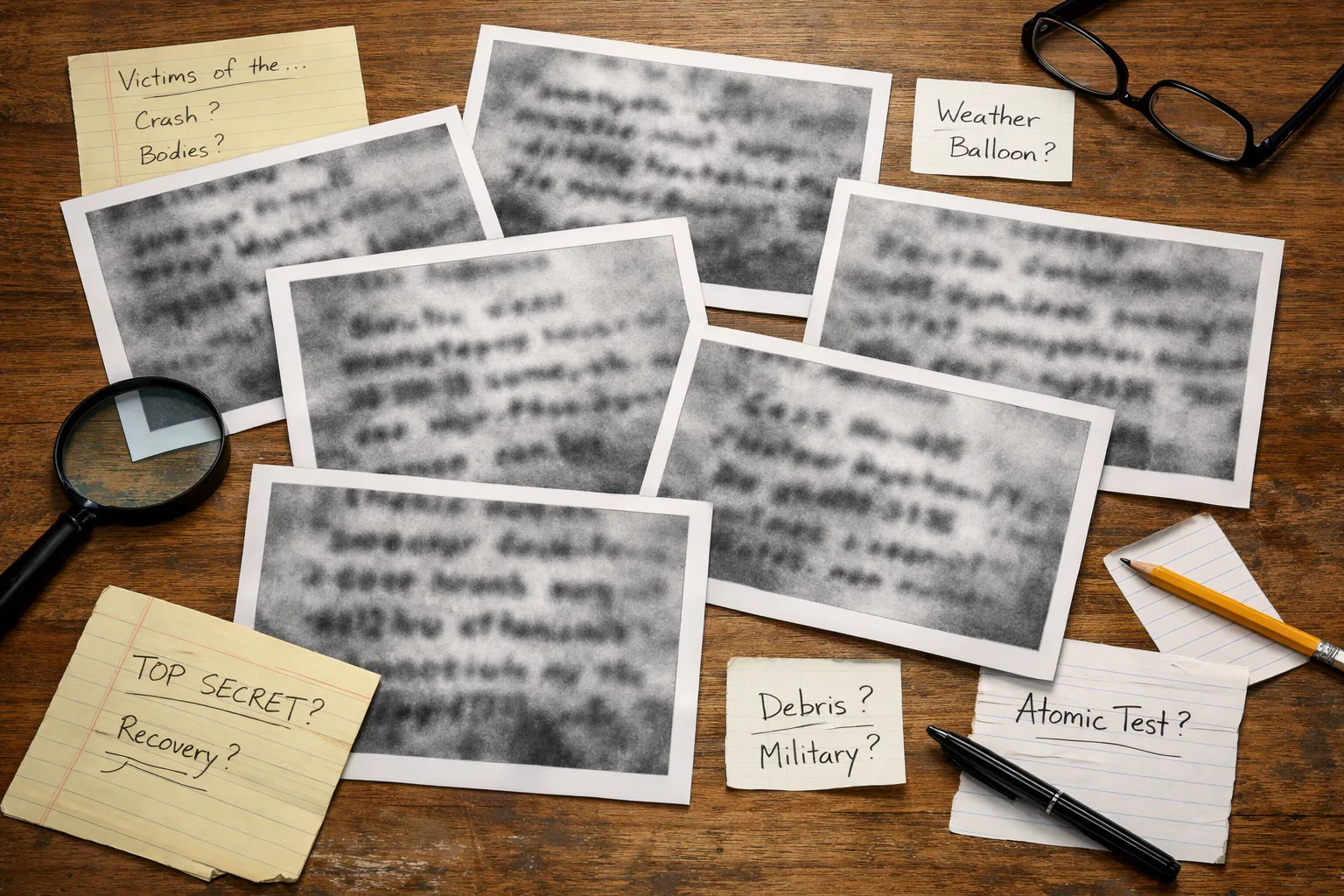
Houran and Randle’s suggestion experiment matters because it tested a simple but decisive question in the Roswell Ramey memo debate: when people look at a tiny, degraded photographed document, are they reading text from the image, or are they partly reading words supplied by context? Their 2002 peer-reviewed article in the Journal of Scientific Exploration did not settle what General Roger Ramey’s paper said. It showed something more useful: some words appear to attract agreement, but suggested story frames can change both how many words people think they see and what kind of words they report.[University of Adelaide Digital Library]digital.library.adelaide.edu.auOpen source on edu.au.
That finding cuts both ways. It weakens confident readings such as “victims of the wreck” if they depend on a Roswell crash narrative being in the reader’s mind. But it also does not prove the memo is meaningless noise. Houran and Randle’s own participants repeatedly agreed on words such as “Fort Worth TX”, “story” and “weather balloons”, suggesting that parts of the image may be genuinely legible while the larger message remains highly vulnerable to expectation, motivation and pattern-finding.[ResearchGate]researchgate.netOpen source on researchgate.net.
Why This Experiment Was Needed
The Ramey memo is unusually tempting evidence because it is tied to the original 1947 Roswell news cycle. In the Fort Worth photographs, Ramey is shown with debris while holding a paper that appears to contain text. The University of Texas at Arlington identifies J. Bond Johnson as the Fort Worth Star-Telegram photographer who captured the only known images of the wreckage on 8 July 1947, and the photo archive context gives the image a provenance that later Roswell testimony often lacks.[Flickr]flickr.comOpen source on flickr.com.
The difficulty is that provenance is not the same thing as readability. Earlier official and specialist attempts had already warned that the visible marks were too poor for secure interpretation. Houran and Randle noted that former NASA scientist Richard Haines could see vague words or occasional letters but could not make out useful text, while a government-linked photo-interpretation effort reported that the digitised photographs were of insufficient quality for the details sought.[ResearchGate]researchgate.netOpen source on researchgate.net.
The experiment was designed for that gap between “there is probably text there” and “we know what it says”. The authors argued that the memo was an ambiguous stimulus, meaning that observers had to fill in missing visual information. In mainstream perception research, that is exactly where expectations and context become powerful: studies of ambiguous perception show that prior knowledge, recent experience and internal states can shape what a person perceives when the sensory evidence is incomplete.[ResearchGate+2PMC]researchgate.netOpen source on researchgate.net.

How the Test Worked
Houran and Randle recruited 176 self-selected participants, with a mean age of 37.4 years, and randomly assigned them to one of three suggestion conditions. Each group was asked to decipher the same Ramey memo material, but the framing changed. One group was told the document might concern the crash, retrieval and cover-up of an extraterrestrial craft near Roswell in July 1947. A second group was told it might concern secret atomic bomb testing. A third group received the neutral instruction that it was a photograph of a document.[ResearchGate]researchgate.netOpen source on researchgate.net.
The materials were not just a casual internet image. Participants viewed an enlarged print of the memo area from Kevin Randle’s collection, obtained from the Fort Worth Star-Telegram Photograph Collection at the University of Texas at Arlington Libraries, as well as computer displays from Stanton Friedman’s CD-ROM scans. These included several high-resolution views of the memo portion, including a negative, an 8 × 10 enlargement, an older 8 × 10 memo-area print and an 11 × 14 memo-area print made in 1998.[ResearchGate]researchgate.netOpen source on researchgate.net.
The procedure was deliberately simple. Each participant worked individually in a quiet room, received a magnifying glass, viewed the images on a computer monitor, and wrote down line by line any characters or words they believed they could see in the ten-line block of text. There was no time limit. A research assistant who was blind to the authors’ goals and hypotheses helped participants handle the CD-ROM images.[ResearchGate]researchgate.netOpen source on researchgate.net.
That design made the experiment less about photographic enhancement and more about interpretation under ambiguity. The same visual stimulus was placed inside three different mental frames. If the image alone determined the readings, the groups should have produced broadly similar results. If context mattered, the groups should have seen different patterns.
What Readers Agreed On
The most important caution is that the experiment did not reduce the memo to pure imagination. Across the three groups, participants showed agreement on several words in identical locations. Houran and Randle reported cross-condition agreement for “Fort Worth TX” with 52 participants, “story” with 61 participants, and “weather balloons” with 27 participants. The word “land” also attracted relative agreement, though mainly in the two suggested-context groups.[ResearchGate]researchgate.netOpen source on researchgate.net.
That agreement matters because it prevents an over-sceptical reading of the study. The result was not “people see anything at all”. It was closer to this: some parts of the memo may contain recoverable word-shapes, but those islands of apparent readability do not automatically reveal the whole message. The strongest agreed words are also not one-sided in the Roswell debate. “Fort Worth” fits the location of the press event. “Story” fits a news or public-relations context. “Weather balloons” can be read as consistent with the official explanation, with a cover story, or with a document discussing the public explanation rather than the underlying event.
This is why the experiment is so relevant to the famous disputed phrase “victims of the wreck”. The article’s comparison table showed earlier investigators disagreeing over the same line, from variants of “victims of the wreck” to John Kirby’s alternative reading, “remains of the material you commanded we fly”. The presence of competing readings in the same physical location is exactly the kind of problem the experiment was meant to test.[ResearchGate]researchgate.netOpen source on researchgate.net.
What Suggestion Changed
The clearest quantitative result was that suggestion changed how much people thought they could read. The suggestion condition significantly affected the number of words deciphered, with Houran and Randle reporting F(2,173) = 63.08, p<.001. Participants in the Pro-Roswell condition reported an average of 4.6 words, those in the Atomic Bomb condition 4.8 words, and those in the blind control condition only 1.6 words.[ResearchGate]researchgate.netOpen source on researchgate.net.
The content shifted too. In the Pro-Roswell condition, participants tended to report words that matched earlier UFO-oriented interpretations, including terms such as “remains”, “weather balloons” and “land”. In the Atomic Bomb condition, the context generated a different vocabulary: participants reported terms such as “flash”, “glasses” and “atomic”. The blind group produced fewer interpretations, and its reported content did not strongly reflect any particular scenario.[ResearchGate]researchgate.netOpen source on researchgate.net.
This is the mechanism in miniature. The same blurry marks became more word-like when participants were given a dramatic frame, and the frame helped decide which words were plausible. The Roswell prompt did not merely make people more interested; it gave them a semantic menu. The atomic-bomb prompt did the same, but with a different menu. The neutral prompt left participants with less context to draw on, and they reported fewer words.
The authors also found that prior exposure to UFO and Roswell information was positively associated with the number of words “deciphered”. That does not mean knowledgeable researchers were dishonest. It means that knowledge can become a perceptual aid and a perceptual hazard at the same time: it helps a reader generate possibilities, but it also makes the reader more likely to complete uncertain fragments in a familiar direction.[ResearchGate]researchgate.netOpen source on researchgate.net.
Why “Context Creates Words” Is Not Just a Debunking Slogan
The experiment is sometimes easy to summarise too bluntly: people saw what they wanted to see. Houran and Randle’s actual point was subtler. They accepted that parts of the memo may be readable, but argued that meaning and context remained ambiguous because suggestion effects and cognitive style strongly influenced interpretation. They also criticised weak inter-rater reliability among earlier analysts, meaning that experienced interpreters did not reliably converge on the same text.[ResearchGate]researchgate.netOpen source on researchgate.net.
That distinction is important for fair evaluation. The study does not prove the memo says nothing about Roswell. It does not prove “weather balloons” is the correct core reading. It does not prove “victims of the wreck” is impossible. What it does show is that any confident reconstruction must survive a stricter test than “a motivated researcher can see it after enhancement”.
The best way to understand the study is as a warning about reverse engineering. Once a researcher assumes that the memo is about a crash, a cover-up, a press strategy or an atomic incident, every unclear stroke can be tested against that assumed storyline. A partial mark becomes the start of a known name; a gap becomes a plausible military phrase; a smudge becomes punctuation. Houran and Randle specifically warned that working backwards from context could lead interpreters to find words that are not actually present.[ResearchGate]researchgate.netOpen source on researchgate.net.
What the Study Implies for Future Memo Claims
Houran and Randle did not recommend abandoning the memo. They recommended making future work harder to fool. Their proposed standard was independent, blind analysis by at least three laboratories specialising in reading and transcribing archival documents, using standardised enhancement methods and the best available raw data. The point would be to measure inter-rater reliability: whether separate experts, without Roswell priming, agree on the same words in the same places.[ResearchGate]researchgate.netOpen source on researchgate.net.
They also endorsed testing the method against known text. One referee suggested using an identical camera and several military messages from the same era, photographing them from different distances and angles, and then seeing whether analysts could recover the known wording. That would answer a crucial control question: under conditions similar to the Ramey photo, is reliable decipherment even possible?[ResearchGate]researchgate.netOpen source on researchgate.net.
This is the experiment’s lasting value. It turns the Ramey memo debate away from a contest of dramatic readings and towards a testable standard. A future claim should be stronger if it is produced blind, independently replicated, tied to precise image locations, and validated against control photographs of known documents. A claim should be weaker if it appears only after the interpreter already knows the Roswell storyline and uses that storyline to fill missing letters.
The Bottom Line
Houran and Randle’s suggestion experiment is key because it explains why the Ramey memo can feel readable without being securely solved. It found that some fragments attracted real agreement, especially “Fort Worth TX”, “story” and “weather balloons”. It also found that context changed what people reported, how many words they thought they saw, and whether their readings leaned towards Roswell, atomic testing or no clear scenario.[ResearchGate]researchgate.netOpen source on researchgate.net.
For the Roswell debate, that means the memo remains potentially interesting but evidentially fragile. Its strongest role is not as a stand-alone proof of alien bodies, a cover-up, or a balloon explanation. Its strongest role is as a case study in how ambiguous historical evidence can become over-interpreted when image limits, prior belief and suggestive context all meet on the same tiny piece of photographed paper.
Amazon book picks
Further Reading
Books and field guides related to When Context Creates Words. Use these as the next step if you want deeper reading beyond the article.
Mistakes Were Made (but Not by Me)
Explains how expectations and beliefs shape interpretation.
The Demon-Haunted World
Rating: 4.5/5 from 43 Google Books ratings
Examines how people interpret ambiguous evidence.
Thinking, Fast and Slow
Directly relevant to perception, pattern recognition, and judgment.
eBay marketplace picks
Marketplace Samples
Live-tested eBay searches with available results related to this page.
Endnotes
1.
Source: researchgate.net
Link:https://www.researchgate.net/profile/James-Houran/publication/228706129_A_Message_in_a_Bottle_Confounds_in_Deciphering_the_Ramey_Memo_from_the_Roswell_UFO_Case/links/0deec527833e585cd6000000/A-Message-in-a-Bottle-Confounds-in-Deciphering-the-Ramey-Memo-from-the-Roswell-UFO-Case.pdf
2.
Source: flickr.com
Link:https://www.flickr.com/photos/spcouta/36080122212
3.
Source: pmc.ncbi.nlm.nih.gov
Link:https://pmc.ncbi.nlm.nih.gov/articles/PMC4259127/
4.
Source: researchgate.net
Link:https://www.researchgate.net/publication/228706129_A_Message_in_a_Bottle_Confounds_in_Deciphering_the_Ramey_Memo_from_the_Roswell_UFO_Case
5.
Source: researchgate.net
Link:https://www.researchgate.net/figure/Close-up-of-the-memo-section-of-the-photograph-of-Brigadier-General-Roger-M-Ramey_fig2_228706129
6.
Source: researchgate.net
Title: 297491206 Ramey memo meant to deceive 3 multiple letters
Link:https://www.researchgate.net/publication/297491206_Ramey_memo_meant_to_deceive_3_multiple_letters
7.
Source: researchgate.net
Link:https://www.researchgate.net/publication/362854511_A_Grounded_Theory_Update_on_the_Roswell_UFO_Incident
8.
Source: researchgate.net
Link:https://www.researchgate.net/publication/221867769_United_we_sense_divided_we_fail_Context-driven_perception_of_ambiguous_visual_stimuli
9.
Source: researchgate.net
Link:https://www.researchgate.net/publication/360168477_Pareidolia_in_a_Built_Environment_as_a_Complex_Phenomenological_Ambiguous_Stimuli
10.
Source: ramey-memo.com
Title: 7 SNAPSHOTS FOR ETERNITY
Link:https://www.ramey-memo.com/7-snapshots-for-eternity/
11.
Source: digital.library.adelaide.edu.au
Link:https://digital.library.adelaide.edu.au/dspace/handle/2440/3334
12.
Source: sites.libraries.uta.edu
Link:https://sites.libraries.uta.edu/roswell/home
13.
Source: sgp.fas.org
Link:https://sgp.fas.org/othergov/roswell.html
14.
Source: facebook.com
Link:https://www.facebook.com/startelegram/photos/this-photo-and-others-in-the-star-telegrams-roswell-collection-by-reporter-j-bon/10155588626153530/
Additional References
15.
Source: youtube.com
Title: A Different Perspective with Kevin Randle Interviews
Link:https://www.youtube.com/watch?v=sp9mWFAI1Y0
Source snippet
A Different Perspective with Kevin Randle - EP 030 - Brenda McClurkin - The Ramey Memo...
16.
Source: youtube.com
Title: XZBN UFO Files
Link:https://www.youtube.com/watch?v=r3E-nA9NkC8
Source snippet
A Different Perspective with Kevin Randle Interviews - DAVID [RUDIAK]({{ 'rudiak/' | relative_url }}) - Decoding the Ramey Memo...
17.
Source: youtube.com
Title: The Roger Ramey Memo, with David Rudiak
Link:https://www.youtube.com/watch?v=YdXwvdvr_Ps
Source snippet
Ramey Memo Roswell photo interpretation The Ramey Memo - Poison in the Balls (LIVE) from the documentary SOCIAL MEDIA MONSTER sonnyboo...
18.
Source: youtube.com
Title: A Different Perspective with Kevin Randle
Link:https://www.youtube.com/watch?v=bYrgqf-X0aM
Source snippet
The Smoking Gun Of Roswell The Ramey Memo...
19.
Source: semanticscholar.org
Link:https://www.semanticscholar.org/paper/%22A-message-in-a-bottle%3A%22-Confounds-in-deciphering-Houran-Randle/0a08310d1ace75c161c8fef55cd69c68c89f7859
20.
Source: michaelanees.com
Link:https://michaelanees.com/s/Nees-Phillips-2015-Applied-Cognitive-Psychology-author-preprint.pdf
21.
Source: x.com
Link:https://x.com/BrianRoemmele/status/1602386927159689216?lang=en
22.
Source: reddit.com
Link:https://www.reddit.com/r/ufo/comments/1t7mqxl/did_the_us_just_quietly_confirm_the_roswell/
23.
Source: academia.edu
Link:https://www.academia.edu/144097753/Rameys_Memo_An_In_Depth_Scientifically_Based_Deep_Research_Study
24.
Source: semanticscholar.org
Link:https://www.semanticscholar.org/paper/Statement-Validity-Analysis-of-%C2%AA-The-Jim-Ragsdale-%3A-Houran-Porter/e5914bfd1c1ff41560c02ced9894269a2d9287c9
Topic Tree