Within Ramey Memo
The Photographer Behind the Memo
Johnson matters twice: as the 1947 photographer and as a later participant in attempts to read the paper in Ramey's hand.
On this page
- The Fort Worth assignment
- Later interpretation efforts
- Why his role is unusual
Page outline Jump by section
Introduction
J. Bond Johnson matters in the Ramey memo story for two separate reasons. First, he was the Fort Worth Star-Telegram photographer whose 8 July 1947 images put Brigadier General Roger M. Ramey, the Roswell debris, and the now-famous paper in the same frame. Second, decades later, Johnson became part of the effort to interpret that paper, including the controversial claim that it contained language such as “victims of the wreck”. His role is therefore unusual: he is both the creator of the key photographic evidence and a later witness-interpreter whose changing recollections affect how the memo is judged. The most secure fact is the photograph’s provenance; the weaker part is Johnson’s later memory of what the paper was and how it got into Ramey’s hand. UTA Special Collections states that Johnson took the only known images of the wreckage and that the original negatives are held in the Fort Worth Star-Telegram Collection.[Flickr]flickr.comOpen source on flickr.com.
The Fort Worth assignment
Johnson entered the Roswell story as a working newspaper photographer, not as a UFO investigator. The immediate setting was Fort Worth Army Air Field on 8 July 1947, after debris from Roswell had been brought to the Eighth Air Force headquarters and displayed for the press. In the surviving images, Ramey, Colonel Thomas DuBose, and Major Jesse Marcel appear with debris presented as balloon-related material. In one of Johnson’s Ramey-DuBose photographs, Ramey holds a paper angled toward the camera just enough for later viewers to see possible lines of text, but not enough for ordinary reading.[ResearchGate]researchgate.netOpen source on researchgate.net.
The University of Texas at Arlington’s archival description is important because it anchors the image in the original 1947 news event. It identifies the source as the Fort Worth Star-Telegram Collection, gives the date as 8 July 1947, names Johnson as the photographer, and notes that the memo in Ramey’s hand has been closely examined without being definitively deciphered. That makes Johnson’s photograph different from many later Roswell claims: the debate starts from an authenticated press image rather than from a late recollection or an alleged secret document with uncertain custody.[Flickr]flickr.comOpen source on flickr.com.
Johnson also appears to have taken a sequence of photographs rather than one isolated shot. Houran and Randle’s 2002 study says Johnson took six of the seven photographs in Ramey’s office, and later reconstructions of the session describe shots of Ramey alone, Ramey with DuBose, and Marcel with the displayed debris. The exact order and details matter because the memo appears only in certain frames, making it possible to ask whether Ramey was already holding it, picked it up, or received it as a prop during the photo session.[ResearchGate]researchgate.netOpen source on researchgate.net.
The memo entered the story by accident
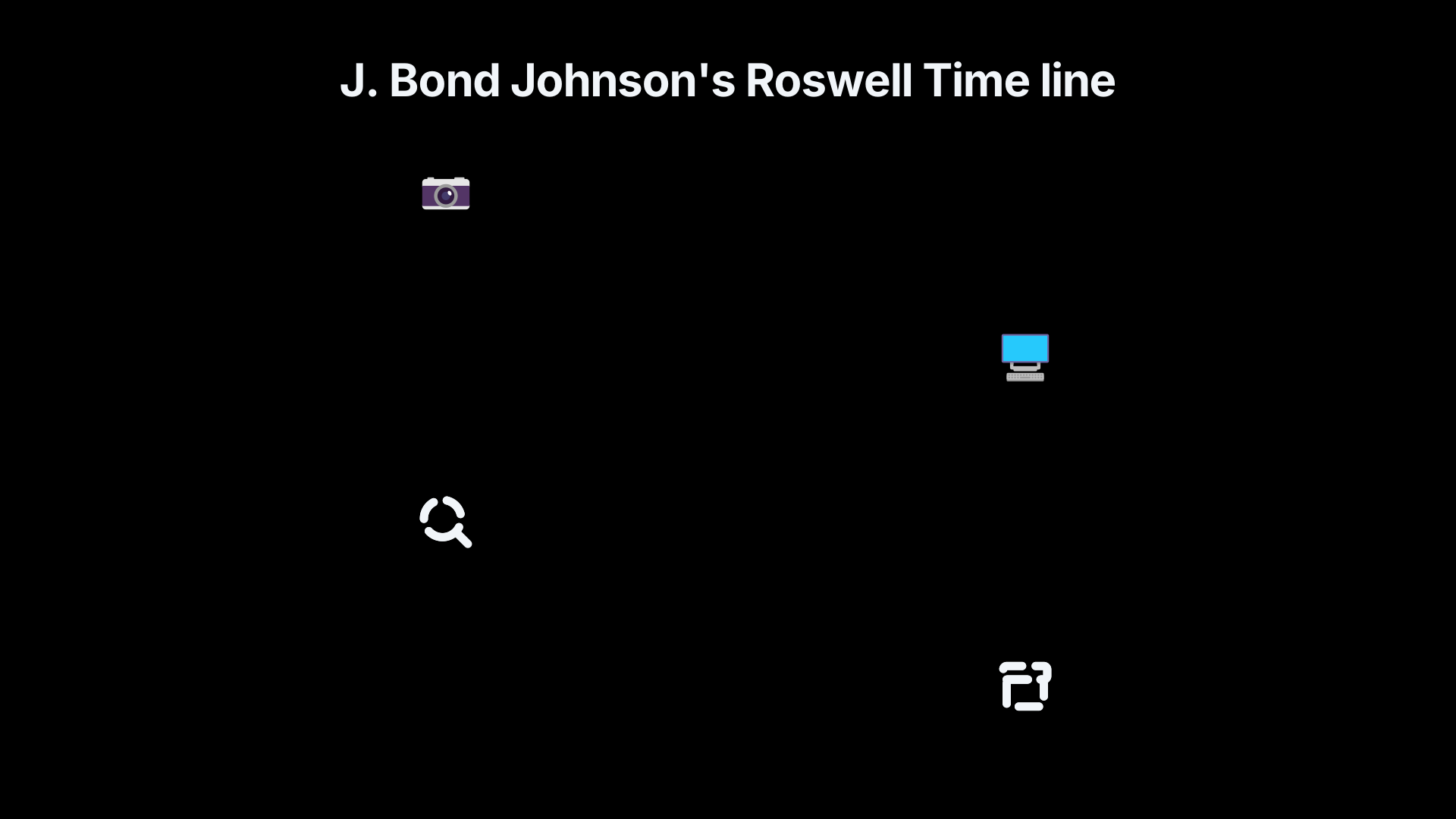
The Ramey memo became famous not because Johnson intentionally photographed a document, but because a document happened to be visible in a picture made for a different purpose. The image was meant to show the debris and the military explanation; the paper became significant only after later researchers enlarged the photograph and noticed that it might contain readable text. The Air Force’s own Roswell review later noted that one Ramey photograph showed a folded paper with nothing visible, while another appeared to show text, but its digitising effort found the photos too poor in quality to visualise the details sought for analysis.[ResearchGate]researchgate.netOpen source on researchgate.net.
This accident of composition is central to Johnson’s importance. A photographer trying to produce a usable news picture created the one frame that later researchers treated as a possible documentary leak. The paper was not preserved as a document; no original memo has surfaced; and the debate depends on extracting words from a small, angled, grainy part of a press photograph. Johnson’s image therefore supplies unusually strong provenance for the existence of the paper, but very weak conditions for reading its contents.[Flickr]flickr.comOpen source on flickr.com.
That distinction is easy to miss. Johnson’s photograph proves that Ramey held a paper during the Fort Worth session. It does not, by itself, prove that the paper was a classified message, a press teletype, a draft statement, or an operational military communication. The most consequential later arguments about the memo are therefore not only about image enhancement. They are also about Johnson’s memory, newsroom practice, military security habits, and whether the visible text pattern looks more like an official message or an ordinary wire-service printout.
Later interpretation efforts
Johnson re-entered the Ramey memo story in the late 1990s, after earlier attempts had produced little agreement. Houran and Randle report that Don Schmitt sent a copy of the photograph to former NASA researcher Richard Haines in 1991; Haines saw vague marks but could not make out useful letters. The matter then changed in 1998, when Johnson assembled a team, including space and satellite engineer Ron Regehr, and used enlargement, computer work, software, camera equipment, and a large blow-up to inspect the paper.[ResearchGate]researchgate.netOpen source on researchgate.net.
Johnson’s team produced one of the most discussed proposed readings. Their fragmentary interpretation included phrases such as “THE VICTIMS OF THE”, “AT FORT WORTH, TEX”, “THE ‘CRASH’ STORY”, “EMERGENCY POWERS”, “MAGDALENA, NMEX”, and “WEATHER BALLOONS”. If those words were securely read, they would be highly significant because they would appear to tie the memo directly to Roswell and possibly to something more dramatic than balloon debris. But even Houran and Randle, writing within a UFO-research context rather than as simple debunkers, stressed that there were major gaps and that some phrases made little sense in context.[ResearchGate]researchgate.netOpen source on researchgate.net.
The problem was not merely sceptical resistance. Other investigators who worked from the same general material did not reproduce Johnson’s reading. Neil Morris, associated with the Johnson Roswell Photo Interpretation Team, kept some elements such as “victims” and “Fort Worth, Texas”, but changed much of the surrounding text. John Kirby read the crucial line differently, reportedly as “are the remains of the material you commanded we fly”, which would shift the phrase away from bodies and towards debris. Russ Estes, using professional imaging equipment and very high-resolution scanning, said he could not reliably decipher the text, though he could make a limited-confidence guess at something like “Fort Work, Tex”.[ResearchGate]researchgate.netOpen source on researchgate.net.
That divergence is why Johnson’s later role cuts both ways. His team helped make the memo a major Roswell talking point, but the lack of convergence also weakened the claim that the text had been objectively recovered. A later psychological study by Houran and Randle found that participants often reported seeing words in the memo, but their results appeared influenced by the suggestions they were given about the document’s possible context. The authors concluded that some words in consistent locations might be readable, but that future work needed blind, triangulated analysis and that there was no substitute for the original document or a verifiable copy.[ResearchGate]researchgate.netResearch Gate(PDF) “A Message in a Bottle:” Confounds in DecipheringResearch Gate(PDF) “A Message in a Bottle:” Confounds in Deciphering
The disputed source of the paper
Johnson’s most delicate contribution is not only that he took the photograph or joined later reading attempts. It is also that he gave accounts suggesting different possible origins for the paper. In one version, Johnson said he brought a news-wire “flash” or teletype message from the Fort Worth Star-Telegram and handed it to Ramey, who then held it while being photographed. In another version, the paper was already on Ramey’s desk and Johnson handed it to him as a prop. A third possibility, discussed by later writers, is that Ramey already had the paper in hand.[ramey-memo.com]ramey-memo.com7 SNAPSHOTS FOR ETERNITY – Unlocking The Mystery7 SNAPSHOTS FOR ETERNITY – Unlocking The Mystery
The difference matters enormously. If Johnson brought the paper from the newsroom, the memo could still mention Roswell, Fort Worth, and balloon explanations, but it would not be a secret military message accidentally exposed to the camera. It would be a civilian news teletype, valuable for understanding the press moment but much weaker as evidence of a hidden military admission. Kevin Randle, who wrote extensively on the memo, argued that Johnson’s account of handing Ramey the flash message would make the source non-military and would explain why the paper might contain words connected to the Roswell story without being a classified document.[kevinrandle.blogspot.com]kevinrandle.blogspot.comA Different Perspective: UFOs, the Ramey Memo, J. Bond Johnson and MeA Different Perspective: UFOs, the Ramey Memo, J. Bond Johnson and Me
If, however, the paper came from Ramey’s desk or from Ramey himself, its evidential weight could be greater. It might have been a military message, a draft statement, or an internal summary. That is why some Roswell researchers reject or minimise the “civilian teletype” version. Randle’s own comment section preserved David Rudiak’s counterargument that Johnson had recanted the civilian-wire claim and that a sensitive document could have been photographed through a human slip-up rather than through deliberate disclosure.[kevinrandle.blogspot.com]kevinrandle.blogspot.comA Different Perspective: General Ramey and His MemoA Different Perspective: General Ramey and His Memo
The result is not a tidy witness record. Johnson is indispensable as the photographer, but unreliable as a final authority on the document’s origin. The strongest cautious position is that his later recollections create hypotheses rather than settle the matter. They show why the paper might have been mundane, but they do not prove that it was. They also show why the memo’s meaning cannot be decided by a single phrase such as “victims” without first establishing what kind of document Ramey was holding.
Why his role is unusual
Johnson’s role is unusual because he sits on both sides of the evidence. In 1947, he was a young working journalist producing a news photograph under ordinary deadline conditions. Decades later, he became a participant in the interpretive culture surrounding that photograph. That gives him more direct connection to the image than almost anyone else in the debate, but it also makes his later statements unusually consequential and unusually vulnerable to memory problems.
The photographer’s role normally ends when the negative is made. In the Ramey memo story, Johnson’s role expanded into three separate functions:
- Provenance witness: His authorship ties the photograph to the Fort Worth Star-Telegram, the 8 July 1947 press session, and original negatives held by UTA Special Collections.[Flickr]flickr.comOpen source on flickr.com.
- Scene witness: His later descriptions of the office, the debris, and the paper became part of arguments about whether the memo was staged, incidental, military, or civilian.[kevinrandle.blogspot.com]kevinrandle.blogspot.comA Different Perspective: UFOs, the Ramey Memo, J. Bond Johnson and MeA Different Perspective: UFOs, the Ramey Memo, J. Bond Johnson and Me
- Interpretation participant: His 1998 team promoted a reading that helped turn the memo into one of the most debated Roswell artefacts, while subsequent analyses failed to produce stable agreement.[ResearchGate]researchgate.netOpen source on researchgate.net.
That combination is rare. Johnson strengthened the Ramey memo’s status by taking a real, dated, archived photograph. At the same time, his later involvement complicated the story because he was no longer only a source of the image; he became a source of claims about what the image meant. The more the debate depends on his memory rather than on the negative itself, the weaker it becomes.

What Johnson adds, and what he cannot settle
Johnson adds a firm historical anchor to the Ramey memo story. Without his photograph, there would be no visible paper to debate. Without the Star-Telegram provenance and UTA-held negatives, the memo would resemble many weaker Roswell claims that depend on late testimony or unverified documents. His picture is why the memo remains interesting even to cautious readers: it is a real image from the original news cycle, not a later reconstruction.[Flickr]flickr.comOpen source on flickr.com.
Johnson cannot settle the central question: what did the paper say? His team’s reading gave the debate some of its most famous language, but other technically informed attempts produced different readings or no reliable reading at all. The strongest published caution is that the memo may contain a few recoverable words, but its broader reconstruction is highly vulnerable to expectation, context, and pattern-seeing in ambiguous visual material.[ResearchGate]researchgate.netResearch Gate(PDF) “A Message in a Bottle:” Confounds in DecipheringResearch Gate(PDF) “A Message in a Bottle:” Confounds in Deciphering
He also cannot settle the paper’s origin. His accounts support the possibility that Ramey was holding a civilian news-wire item, a prop, or a document already in the office. Each possibility changes the memo’s evidential value. A civilian teletype could explain Roswell-related words without implying a hidden military admission; a military message would be more significant, but still would need a reliable reading and a clear explanation for why a senior officer allowed it to be photographed.[ramey-memo.com]ramey-memo.com7 SNAPSHOTS FOR ETERNITY – Unlocking The Mystery7 SNAPSHOTS FOR ETERNITY – Unlocking The Mystery
The best way to understand Johnson, then, is not as the man who proved or disproved the Roswell memo. He is the reason the memo exists as evidence at all, and also a reminder of the limits of that evidence. His photograph gives the debate its strongest foundation. His later recollections and reading efforts show why the structure built on that foundation remains unstable.
Amazon book picks
Further Reading
Books and field guides related to The Photographer Behind the Memo. Use these as the next step if you want deeper reading beyond the article.
Witness to Roswell
Covers key evidence, witnesses, and controversies surrounding Roswell, including photographic and documentary debates.
Roswell Incident
Provides the foundational Roswell narrative within which the Ramey memo photographs and J. Bond Johnson's role are discussed.
The Roswell UFO Crash
Examines controversies and claims surrounding Roswell evidence, including challenges to popular interpretations.
Roswell
For over fifty years an incident near Roswell, New Mexico, has sparked the imaginations of UFO enthusiasts. Did the military recover a cr...
eBay marketplace picks
Marketplace Samples
Live-tested eBay searches with available results related to this page.
Endnotes
1.
Source: flickr.com
Link:https://www.flickr.com/photos/spcouta/36080122212
2.
Source: researchgate.net
Link:https://www.researchgate.net/profile/James-Houran/publication/228706129_A_Message_in_a_Bottle_Confounds_in_Deciphering_the_Ramey_Memo_from_the_Roswell_UFO_Case/links/0deec527833e585cd6000000/A-Message-in-a-Bottle-Confounds-in-Deciphering-the-Ramey-Memo-from-the-Roswell-UFO-Case.pdf
3.
Source: researchgate.net
Title: Research Gate(PDF) “A Message in a Bottle:” Confounds in Deciphering
Link:https://www.researchgate.net/publication/228706129_A_Message_in_a_Bottle_Confounds_in_Deciphering_the_Ramey_Memo_from_the_Roswell_UFO_Case
4.
Source: ramey-memo.com
Title: 7 SNAPSHOTS FOR ETERNITY – Unlocking The Mystery
Link:https://www.ramey-memo.com/7-snapshots-for-eternity/
5.
Source: kevinrandle.blogspot.com
Title: A Different Perspective: UFOs, the Ramey Memo, J. Bond Johnson and Me
Link:https://kevinrandle.blogspot.com/2009/10/ufos-ramey-memo-j-bond-johnson-and-me.html
6.
Source: kevinrandle.blogspot.com
Title: A Different Perspective: General Ramey and His Memo
Link:https://kevinrandle.blogspot.com/2009/05/general-ramey-and-his-memo.html
7.
Source: researchgate.net
Link:https://www.researchgate.net/publication/362854511_A_Grounded_Theory_Update_on_the_Roswell_UFO_Incident
8.
Source: researchgate.net
Link:https://www.researchgate.net/publication/362854511_A_Grounded_Theory_Update_on_the_Roswell_UFO_Incident/fulltext/63a499df097c7832ca5912b6/A-Grounded-Theory-Update-on-the-Roswell-UFO-Incident.pdf
9.
Source: sites.libraries.uta.edu
Link:https://sites.libraries.uta.edu/roswell/node/21
10.
Source: sites.libraries.uta.edu
Link:https://sites.libraries.uta.edu/roswell/home
11.
Source: ramey-memo.com
Title: National-Level Organization FAILED
Link:https://www.ramey-memo.com/national-level-organization-failed/
12.
Source: kevinrandle.blogspot.com
Title: The Ramey Memo
Link:https://kevinrandle.blogspot.com/2018/12/the-ramey-memo-latest-information.html
13.
Source: iconicphotos.wordpress.com
Title: roswell memo
Link:https://iconicphotos.wordpress.com/2018/05/31/roswell-memo/
Additional References
14.
Source: youtube.com
Link:https://www.youtube.com/watch?v=6u0F2_k2o4o
Source snippet
Exposing The Biggest Government Coverup in UFO History | Roswell UFO Crash 1947...
15.
Source: youtube.com
Link:https://www.youtube.com/watch?v=0jyvCrvVWNc
Source snippet
Ross Coulthart weighs in on 'Roswell Incident' video | NewsNation Prime...
16.
Source: youtube.com
Title: Ross Coulthart weighs in on ‘Roswell Incident’ video | News Nation Prime
Link:https://www.youtube.com/watch?v=nrLVpWBxHRA
Source snippet
Kevin Randle Interviews - DR. JAMES HOURAN - JSE, Ramey Memo, UFO Research...
17.
Source: youtube.com
Link:https://www.youtube.com/watch?v=Sn1UTpZQEK4
Source snippet
America's Most Mysterious UFO Cases | Expedition Unknown: Hunt For Extraterrestrials S1E4...
18.
Source: dafhistory.af.mil
Link:https://www.dafhistory.af.mil/Portals/16/documents/AFD-101201-038.pdf
19.
Source: cufos.org
Link:https://cufos.org/PDFs/IUR%20issues/IUR%20Vol.%2015%20No.%206%20Nov.-Dec.%201990.pdf
20.
Source: aol.com
Link:https://www.aol.com/july-long-ago-roswell-incident-103000520.html
21.
Source: scribd.com
Link:https://www.scribd.com/document/488123120/1994-Roswell-Report-Prepared-for-GAO-1994-pdf
22.
Source: nicap.org
Link:https://www.nicap.org/match/papers/Ten_Days_In_July.pdf
23.
Source: ufocasebook.com
Link:https://www.ufocasebook.com/rameymemo.html
Topic Tree