Within Ramey Memo
The Official Answer to Body Stories
The Air Force's body-story explanation matters because the memo's alleged 'victims' wording is often used against it.
On this page
- Dummy drop explanation
- Memory compression claim
- How it relates to the memo
Page outline Jump by section
Introduction
The Air Force’s 1997 report, The Roswell Report: Case Closed, was written to answer a problem left partly open by its 1994 Roswell review: debris could be explained by Project Mogul, but later stories about bodies, autopsies and “victims” still needed an official explanation. Its answer was not that every witness simply invented a story. It argued that many body accounts were memories of real Air Force activities, especially 1950s high-altitude dummy drops, compressed backwards into the famous July 1947 Roswell episode. That matters for the Ramey memo debate because one claimed reading of the tiny paper in General Roger Ramey’s hand includes wording such as “victims of the wreck”. If that phrase were secure, it would appear to support body claims. The Air Force reply was, in effect, that body memories may be real memories attached to the wrong event, wrong year and wrong meaning.[Project Gutenberg]gutenberg.orgThe Roswell Report: Case Closed, by James McAndrew—A Project Gutenberg eBook…
Why Case Closed targeted the body stories
The 1994 Air Force Roswell report focused mainly on the recovered debris and concluded that the 1947 object was probably connected to Project Mogul, a secret balloon programme designed to detect Soviet nuclear tests. But the Roswell story by the 1990s had become much larger than debris. Popular versions included alien bodies, military recovery teams, hospital autopsies, sealed coffins and shipment of remains to Wright-Patterson Air Force Base. The 1997 report was therefore a second-stage official intervention: it tried to explain why “body” testimony had grown around an incident whose contemporary record did not clearly contain bodies.[Air Force]af.milOpen source on af.mil.
The report’s central move was to separate the original 1947 debris recovery from later recollections of “beings”. It said the additional research found that some accounts appeared to describe real Air Force activities, but that those activities “did not occur in 1947”. Its headline conclusions were that Air Force activities over many years had been collapsed into “two or three days in July 1947”, that “aliens” seen in New Mexico were probably anthropomorphic test dummies carried by high-altitude balloons, and that some hospital-body claims were more likely linked to a 1956 KC-97 aircraft accident and a 1959 manned balloon mishap.[Project Gutenberg]gutenberg.orgThe Roswell Report: Case Closed, by James McAndrew—A Project Gutenberg eBook…
That is why the report is best understood as a policy-style counter-narrative rather than a simple technical appendix. It did not just identify hardware. It proposed a mechanism for folklore formation: real Cold War aeromedical work, public misunderstanding, later interviews, and memory compression turned scattered events into a single Roswell crash-and-body story.
The dummy-drop explanation
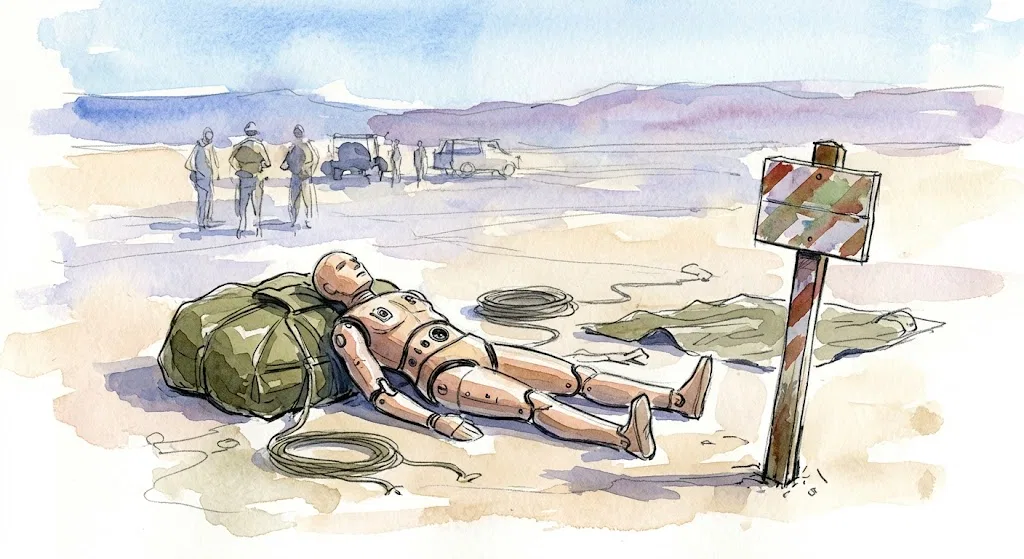
The most concrete part of Case Closed is its account of anthropomorphic dummies. The Air Force traced their development from earlier parachute and ejection-seat testing to more human-like models used in the 1950s. The report says a 1949 proposal sought an improved dummy with a more accurate external appearance for testing helmets, oxygen masks and equipment fit; the resulting “Sierra Sam” type stood 72 inches tall, weighed about 200 pounds and contained instrumentation cavities. Later Alderson dummies used metal skeletons, latex or plastic skin, cast aluminium skulls and internal spaces for gauges and sensors.[Project Gutenberg]gutenberg.orgThe Roswell Report: Case Closed, by James McAndrew—A Project Gutenberg eBook…
The key operational claim is narrower than the phrase “crash test dummies” sometimes suggests. These were not car-crash dummies placed in a 1947 balloon. From 1953 to 1959, the Air Force Aero Medical Laboratory used anthropomorphic dummies in high-altitude escape projects such as High Dive and Excelsior, to test whether pilots or future astronauts could return safely by parachute from extreme altitude. The report says 43 high-altitude balloon flights carrying 67 dummies were launched and recovered across New Mexico between June 1954 and February 1959, with many landing outside military reservations, including areas near Roswell and the Tularosa Valley.[Project Gutenberg]gutenberg.orgThe Roswell Report: Case Closed, by James McAndrew—A Project Gutenberg eBook…
The dummy explanation drew strength from physical details in some witness accounts. Case Closed compared later descriptions of “aliens” with features of damaged or partial dummies: bald heads, plastic-looking skin, missing fingers, missing limbs, flight clothing, bodies viewed from a distance, and recovery teams arriving with military vehicles. It also noted that some witnesses used language such as “plastic dolls”, “dummies”, or “either bodies or dummies”, which the Air Force treated as clues that the memory source was not an extraterrestrial body but a human-shaped test article.[Project Gutenberg]gutenberg.orgThe Roswell Report: Case Closed, by James McAndrew—A Project Gutenberg eBook…
One of the report’s strongest examples comes from Joseph Kittinger’s recollection of dummy recovery work. Kittinger described dummies carried by high-altitude balloons, sometimes incomplete or lacking arms and legs, being tracked and recovered by crews using trucks, communications vans, converted ambulances, cranes, trailers, helicopters and transport aircraft. He recalled that civilians sometimes observed the operations because the aircraft, payloads and recovery activity looked unusual. In one incident at Wright-Patterson, a dummy whose parachute failed reportedly landed in view of officers’ wives, who thought it was a dead or injured parachutist being handled carelessly.[Project Gutenberg]gutenberg.orgThe Roswell Report: Case Closed, by James McAndrew—A Project Gutenberg eBook…
The memory compression claim
The most disputed part of Case Closed is not whether dummy drops happened. They did. The dispute is whether memories of 1950s dummy recoveries can reasonably explain stories that witnesses or later Roswell researchers tied to July 1947. The Air Force’s answer depended on a “memory compression” argument: people may remember a striking event, but misdate it, merge it with other stories, or attach it to the most famous local narrative.
That is plausible in general terms. Modern eyewitness research shows that memory is not a fixed recording. It can be affected by time, suggestion, repeated retelling and post-event information. The National Academies’ review of eyewitness identification stresses that witness evidence depends on limits of perception and memory, while research on the misinformation effect shows that later information can distort recall and lead people to report misleading details as if they belonged to the original event.[National Academies+2National Academies]nationalacademies.orgOpen source on nationalacademies.org.
But plausibility is not the same as proof in a specific historical case. The Air Force had to argue not merely that memory can shift, but that enough witnesses could shift 1950s aeromedical events into the 1947 Roswell frame to explain a major branch of the legend. Critics seized on that weakness. TIME summarised the obvious objection in 1997: the report’s dummies were used between 1954 and 1959, not in 1947, so believers saw the explanation as awkwardly stitched to the wrong date.[Time]time.comaliens or dummiesaliens or dummies
That date gap remains the central critique risk. If a witness’s account is demonstrably first-hand, clearly dated to July 1947, and independent of later Roswell storytelling, dummy drops from 1954 onward cannot directly explain it. The Air Force response was to challenge those premises: many body stories emerged decades later, some were second-hand, and some contained details matching later military activity better than the original debris recovery. The report’s logic works best against late, uncertain, or internally inconsistent body accounts. It works less well as a blanket dismissal of every claimed body-related statement.
What the report handled well
Case Closed is strongest when it ties specific testimony to specific mundane mechanisms. It did not merely say “people saw dummies”. It tried to match reported features to documented equipment and procedures: off-range balloon landings, rapid recovery crews, military vehicles, odd-looking human forms, plastic or latex skin, missing limbs after impact, stretchers, ambulances, and unusual activity around Walker Air Force Base. Those are the kinds of details that can make a prosaic explanation credible because they explain why a sincere observer might later remember something strange.[Project Gutenberg]gutenberg.orgThe Roswell Report: Case Closed, by James McAndrew—A Project Gutenberg eBook…
The report also avoided one simplistic move. It did not claim that all body witnesses were lying. Its working hypotheses allowed that “some event(s) actually did occur” because some accounts were detailed and numerous. That was a more sophisticated response than pure denial: it treated parts of the legend as distorted memory of real military operations rather than total fabrication.[Project Gutenberg]gutenberg.orgThe Roswell Report: Case Closed, by James McAndrew—A Project Gutenberg eBook…
Its hospital section also broadened the explanation beyond dummies. For claims about bodies at the Roswell Army Air Field hospital, the Air Force pointed to two later events: a 1956 KC-97 crash with fatalities and a 1959 manned balloon mishap involving injured pilots. The report argued that burned, damaged, or medically treated airmen could account for some grim body imagery better than dummy recoveries alone. In one passage, it links a witness description of small blackened bodies to autopsy records describing severe burns and loss of lower extremities in the 1956 crash victims.[Project Gutenberg]gutenberg.orgThe Roswell Report: Case Closed, by James McAndrew—A Project Gutenberg eBook…
Where the explanation remains vulnerable
The biggest vulnerability is chronological. The famous Roswell incident happened in July 1947. The high-altitude dummy drops central to the Air Force explanation belong mainly to the 1950s. The report can answer this only by relying on memory relocation, story merging and later contamination. Those processes are real, but in historical argument they must be applied carefully, witness by witness. Used too broadly, “memory compression” can become a catch-all explanation that is hard to falsify.
A second weakness is rhetorical. The phrase “crash test dummies” is easy to ridicule because it sounds as if the Air Force placed modern car-test mannequins into the original 1947 event. That is not the report’s actual claim, but the simplified public version invited the “time-travelling dummies” objection. Even contemporary coverage noted the mismatch between the 1947 Roswell date and the 1954–1959 dummy-drop period.[Time]time.comaliens or dummiesaliens or dummies
A third weakness is source dependence. The report often evaluates witness testimony collected by UFO researchers, then compares it to Air Force records and Air Force participant interviews. That can be useful, but readers should notice the asymmetry: official records are treated as stabilising evidence, while witness narratives are treated as malleable. That may be justified in many cases, especially where claims are late or contradictory, but it means the report’s persuasiveness depends on confidence that relevant official records were complete and honestly interpreted.

How it relates to the Ramey memo
The Ramey memo is a separate evidential problem. It is a 1947 photograph, not a 1950s memory. Its attraction is that it appears in an original news photograph taken during the Fort Worth debris display, so it is not vulnerable to the same late-memory criticism as body testimony. The contested issue is legibility: whether the tiny, angled paper can really be read, and whether words such as “victims” or “victims of the wreck” are present. Research on the memo has produced competing readings rather than a stable text.[sites.libraries.uta.edu]sites.libraries.uta.eduOpen source on uta.edu.
That makes Case Closed relevant but not decisive. If the Ramey memo clearly and independently said “victims of the wreck”, the Air Force’s 1950s dummy explanation would not easily neutralise it, because the memo would be contemporary with July 1947. The body-memory argument explains later testimony; it does not rewrite a 1947 document. The official answer would then need another explanation for the word “victims”, such as ordinary crash-report terminology, a misread word, unrelated communications traffic, or some non-body meaning in military context.
On the other hand, if the memo reading is uncertain, Case Closed changes how much weight the alleged “victims” wording should carry. The broader Roswell body tradition is not a clean independent support for that reading, because the Air Force made a documented case that many body stories may derive from later balloon, dummy and accident memories. In other words, the memo cannot be strengthened simply by pointing to the later body lore; that lore is itself contested and partly explainable without aliens.
The fairest assessment is therefore conditional. The Air Force report weakens the assumption that every Roswell “body” account points back to July 1947. It does not, by itself, disprove a secure contemporary memo reference to victims. The practical question for readers is whether the memo’s alleged wording is strong enough to stand alone. If it is not, then Case Closed supplies a credible reason to be cautious about importing decades of body-memory claims into one blurred 1947 photograph.
The takeaway for the memo debate
The Roswell Report: Case Closed matters because it offers the official answer to the body side of Roswell: not “nothing was ever seen”, but “real Air Force events were remembered, merged and misdated”. Its dummy-drop evidence is concrete, especially where witness descriptions match documented 1950s balloon recovery operations. Its memory-compression theory is plausible but vulnerable, because it carries a heavy burden across a seven-to-twelve-year gap from the original 1947 event.
For the Ramey memo, that means the alleged “victims” wording should not be treated as automatically confirmed by later body stories. The official record gives a non-alien pathway by which “body” narratives could enter Roswell culture after the fact. But the reverse is also true: if a reliable reading of the 1947 memo ever established body-related wording beyond reasonable doubt, Case Closed would not be enough to explain it away. The report is a serious challenge to body-memory claims, not a substitute for solving the memo’s photographic legibility problem.
Amazon book picks
Further Reading
Books and field guides related to The Official Answer to Body Stories. Use these as the next step if you want deeper reading beyond the article.
The Demon-Haunted World
Rating: 4.5/5 from 43 Google Books ratings
Provides a skeptical framework for evaluating claims.
eBay marketplace picks
Marketplace Samples
Live-tested eBay searches with available results related to this page.
Endnotes
1.
Source: gutenberg.org
Title: Project Gutenberg
Link:https://www.gutenberg.org/files/63659/63659-h/63659-h.htm
Source snippet
The Roswell Report: Case Closed, by James McAndrew—A Project Gutenberg eBook...
2.
Source: time.com
Title: aliens or dummies
Link:https://time.com/archive/6930414/aliens-or-dummies/
3.
Source: sites.libraries.uta.edu
Link:https://sites.libraries.uta.edu/roswell/node/21
4.
Source: gutenberg.org
Link:https://www.gutenberg.org/cache/epub/63659/pg63659-images.html
5.
Source: gutenberg.org
Title: 63659 h
Link:https://www.gutenberg.org/files/63659/old/63659-h/63659-h.htm
6.
Source: gutenberg.org
Link:https://www.gutenberg.org/ebooks/63659
7.
Source: air.org
Link:https://www.air.org/
8.
Source: air.inc
Link:https://air.inc/
9.
Source: af.mil
Link:https://www.af.mil/The-Roswell-Report/
10.
Source: nationalacademies.org
Link:https://www.nationalacademies.org/read/18891/chapter/2
11.
Source: nationalacademies.org
Link:https://www.nationalacademies.org/read/18891/chapter/6
12.
Source: military-history.fandom.com
Title: Air Force reports on the Roswell UFO incident
Link:https://military-history.fandom.com/wiki/Air_Force_reports_on_the_Roswell_UFO_incident
13.
Source: Wikipedia
Title: Roswell incident
Link:https://en.wikipedia.org/wiki/Roswell_incident
14.
Source: Wikipedia
Title: Misinformation effect
Link:https://en.wikipedia.org/wiki/Misinformation_effect
15.
Source: ebsco.com
Link:https://www.ebsco.com/research-starters/social-sciences-and-humanities/misinformation-effect
16.
Source: britannica.com
Title: Roswell incident | Overview, Theories, Hoaxes, & Facts
Link:https://www.britannica.com/event/Roswell-incident
17.
Source: jstor.org
Link:https://www.jstor.org/stable/48568428
Additional References
18.
Source: airnow.gov
Link:https://www.airnow.gov/
19.
Source: nsa.gov
Link:https://www.nsa.gov/Helpful-Links/NSA-FOIA/Declassification-Transparency-Initiatives/FOIA-Reports-and-Releases/FOIA-Reports-and-Releases-List/igphoto/2002761379/
20.
Source: nasa.gov
Link:https://www.nasa.gov/scientificballoons/
21.
Source: govinfo.gov
Link:https://www.govinfo.gov/content/pkg/GOVPUB-D301-PURL-gpo92195/pdf/GOVPUB-D301-PURL-gpo92195.pdf
22.
Source: semanticscholar.org
Link:https://www.semanticscholar.org/paper/%22A-message-in-a-bottle%3A%22-Confounds-in-deciphering-Houran-Randle/0a08310d1ace75c161c8fef55cd69c68c89f7859
23.
Source: aircanada.com
Link:https://www.aircanada.com/home/us/en/aco/flights
24.
Source: centennialofflight.net
Link:https://www.centennialofflight.net/essay/Lighter_than_air/Balloons_and_Space/LTA17.htm
25.
Source: reddit.com
Link:https://www.reddit.com/r/UFOB/comments/1jw59s3/cufos_dr_mark_rodeghier_did_the_air_force/
26.
Source: nobaproject.com
Link:https://nobaproject.com/modules/eyewitness-testimony-and-memory-biases
27.
Source: scispace.com
Link:https://scispace.com/pdf/eyewitness-memory-and-misinformation-are-remember-know-2b0k8ie1cn.pdf
Topic Tree