Within Negatives
Can High Resolution Scans Solve It?
High-resolution and tonal work improve access to the surviving image data, but they do not turn ambiguous marks into settled text.
On this page
- What better scans add
- Why tonal range is not the same as text recovery
- How archives should present uncertain image evidence
Page outline Jump by section
Introduction
High-resolution scans can make the Ramey memo easier to inspect, but they cannot by themselves settle what the photographed paper says. The key improvement is access: UTA identifies the memo close-up as a Fort Worth Star-Telegram Collection negative from 8 July 1947, and its Roswell site makes higher-quality memo scans available rather than leaving readers dependent on poor reproductions.[MavMatrix]mavmatrix.uta.eduOpen source on uta.edu. The key limit is also clear: the source is still a small, angled, partly blurred document captured inside a news photograph, not the memo itself. Even sympathetic Roswell researchers have acknowledged that decipherment attempts have not produced definitive results.[journalofscientificexploration.org]journalofscientificexploration.orgA Grounded Theory Update on the Roswell UFO IncidentJournal of Scientific Exploration…
 That distinction matters. Better scanning can reduce avoidable uncertainty caused by bad copies, low-resolution web images, compression and crude contrast boosts. It cannot recover text that was never sharply recorded on the negative, and it cannot remove the role of expectation when viewers try to read ambiguous marks as words.
What Better Scans Add
The value of high-resolution scanning is not that it magically reveals a hidden telegram. It gives researchers a cleaner version of the surviving photographic evidence. UTA’s catalogue entry for the close-up identifies the item as “A Close-up of telegram in Brigadier General Roger Ramey’s hand”, dated 8 July 1947, in the Fort Worth Star-Telegram Collection, with the original format listed as black-and-white negatives.[MavMatrix]mavmatrix.uta.eduOpen source on uta.edu. That provenance gives the image a firmer evidential base than anonymous online copies or heavily processed screenshots.
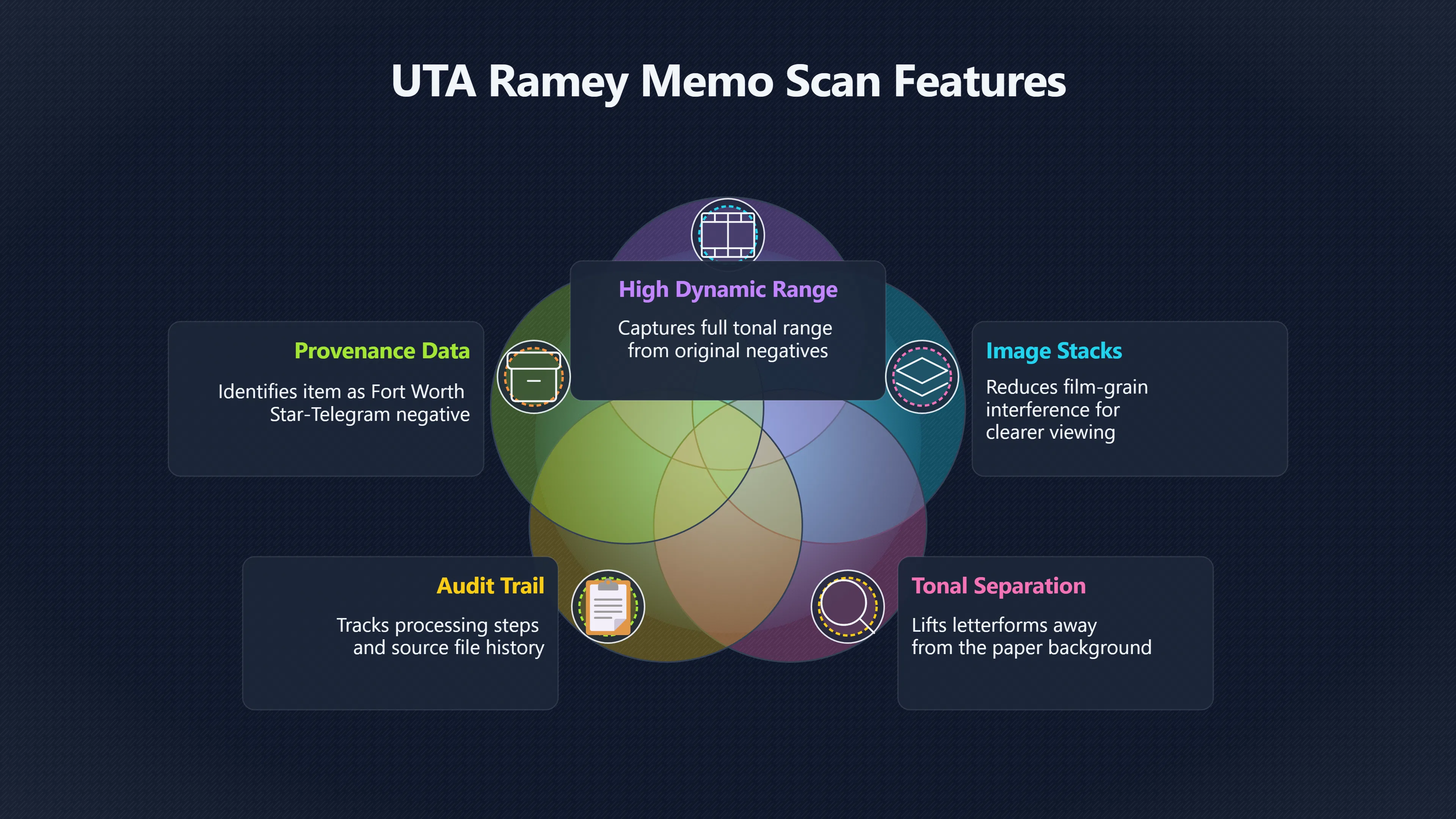
The UTA Roswell site describes the high-resolution Ramey memo work as using high dynamic range photography to capture the tonal range present in the negatives, especially in the memo area. It says the resulting files include image stacks intended to reduce film-grain interference, separate paper tones from type or character tones, and lift tonal values associated with possible letterforms away from the background.[UTA Libraries]sites.libraries.uta.eduLibraries Ramey Memo High Resolution Microfiche Scans ROSWELL UFO INCIDENTTHE… High Dynamic Range photography has been used to harness the range of tones present with negatives and in particular the "memo.Rea… In practical terms, that means researchers can compare several image states rather than relying on one dramatic contrast setting.
That is a real gain. Older public debates often depended on copies of copies: book reproductions, enlarged prints, compressed website images, or individually enhanced versions circulated by advocates. The 2002 Houran and Randle study already noted that participants were shown several then-current high-resolution sources, including a negative image, UTA enlargements and earlier memo-area prints, while also observing that analysts disagreed about the resulting readings.[ResearchGate]researchgate.netOpen source on researchgate.net. Modern archival presentation improves on that situation by letting more people inspect the underlying visual data and compare enhancement choices.
The most useful result is not a single “decoded” transcript. It is a better audit trail: which scan was used, what processing was applied, whether the result came from a negative, a microfiche scan, an enlargement or a derivative file, and whether the same possible word remains visible across multiple treatments. That helps separate cautious visual observations from interpretations that depend on one enhancement setting.
Why Tonal Range Is Not Text Recovery
High dynamic range, contrast adjustment and tonal separation can make faint marks more visible, but visibility is not the same as legibility. A scan can preserve more tonal information from a negative, yet the original photograph still determines the ceiling of what can be recovered. If the paper was out of focus, angled, partly obscured by glare, too small on the negative, or affected by film grain, later processing can emphasise patterns but cannot turn them into reliable text without corroboration.
This is the central trap in the Ramey memo debate. Processing can create several plausible-looking versions of the same small marks. One reader may see a word connected to a crashed “disc”; another may see a mundane wire-service phrase; another may see only broken strokes. The 2002 study described the memo as “inherently ambiguous” because filters limit analysis and shared understanding, and it found that even experienced memo researchers had not reached agreement on its contents.[ResearchGate]researchgate.netOpen source on researchgate.net.
The same paper’s experiment is especially relevant to high-resolution work because it did not merely ask whether people could see anything. It tested how suggestion affected decipherment. Participants were divided into groups told different contexts: Roswell crash and cover-up, atomic bomb testing, or no special context. The authors reported that some parts appeared partly legible, but that meaning and context remained ambiguous and were influenced by suggestion and cognitive style.[ResearchGate]researchgate.netOpen source on researchgate.net.
That finding does not prove all proposed readings are wrong. It means that better scans should be treated as evidence to be tested, not as an invitation to complete uncertain words from expectation. A responsible reading should ask:
- Does the same character or word survive across different scans and tonal settings?
- Can independent readers locate the same word in the same place without being told what to expect?
- Does a proposed word fit the visible marks without adding invisible letters?
- Can the method be tested on known 1940s documents photographed under similar conditions?
- Are rejected alternative readings shown, not merely dismissed?
Houran and Randle made a related recommendation: photograph known military messages with a comparable camera, from varying distances and angles, and test whether the text can be deciphered.[ResearchGate]researchgate.netOpen source on researchgate.net. That would not solve the Ramey memo automatically, but it would establish what similar image data can and cannot support.
The Problem With “Definitive” Readings
The Ramey memo has attracted readings that claim to identify phrases such as “victims of the wreck” or references to a “disc”. Other readings produce more mundane or incomplete wording. The problem is not simply that people disagree; it is that the disagreement sits exactly where the image is weakest. The 2002 comparison table listed sharply different proposed readings by several investigators line by line, while also noting limited areas of possible agreement.[ResearchGate]researchgate.netOpen source on researchgate.net.
That pattern is typical of ambiguous-image evidence. The more a reading depends on interpreting broken strokes, inferred spacing and expected military language, the more it needs controls. A transcript that labels every uncertain mark as a confident word gives readers a false sense of precision. A better presentation distinguishes between visible marks, plausible letters, tentative words and speculative sentence reconstruction.
There is also a risk that image enhancement itself becomes persuasive theatre. A high-contrast version may look more “readable” because it removes grey uncertainty and presents black shapes against a pale background. But those black shapes may include film grain, scanner artefacts, sharpening halos, compression blocks, scratches, dust, glare boundaries or the edges of paper texture. UTA’s own description of producing a range of image states is therefore important: the range is for interpretive evaluation, not a single authorised decipherment.[UTA Libraries]sites.libraries.uta.eduLibraries Ramey Memo High Resolution Microfiche Scans ROSWELL UFO INCIDENTTHE… High Dynamic Range photography has been used to harness the range of tones present with negatives and in particular the "memo.Rea…
The most cautious current position is that high-resolution scans keep the Ramey memo worth studying but still inconclusive. Randle’s 2022 Journal of Scientific Exploration abstract says attempts to decipher the photographed memo have not provided definitive results that would rule out any explanations, while also noting that higher-quality digital scans remain one possible avenue for empirical progress.[journalofscientificexploration.org]journalofscientificexploration.orgA Grounded Theory Update on the Roswell UFO IncidentJournal of Scientific Exploration… That is a balanced statement of the scan problem: better data may improve the discussion, but the available readings have not closed it.
How Archives Should Present Uncertain Image Evidence
For archives, the Ramey memo is a useful case study in how to publish controversial image evidence without overstating it. The archive’s role is not to decide the Roswell debate by caption. It is to preserve the best available source material, describe provenance accurately, disclose technical processing, and prevent derivative copies from becoming substitutes for the evidence.
A strong archival presentation should include several layers:
- Unprocessed reference images: the closest available scan to the negative or preservation master, with no dramatic enhancement.
- Processed working versions: tonal, contrast or HDR-derived files clearly labelled as interpretive aids.
- Technical metadata: scan source, resolution, equipment where known, file format, date of digitisation and whether the image is from a negative, microfiche, print or derivative.
- Version control: stable identifiers for each image state so researchers can cite exactly what they used.
- Uncertainty language: captions that say the memo has been studied but not definitively read, rather than presenting one transcript as settled text.
- Comparative panels: side-by-side views showing how the same mark changes under different tonal treatments.
- Downloadable masters where rights permit: access to high-quality files so outside researchers are not forced to work from screenshots.
UTA’s Roswell pages already move in this direction by linking the memo close-up to an institutional collection and by making high-resolution scan work part of the public record.[MavMatrix]mavmatrix.uta.eduOpen source on uta.edu. The next step for any archive handling similar evidence is not more dramatic enhancement but clearer documentation of how each image was made and what each version is meant to support.

The Practical Test for Future Claims
A future Ramey memo claim should not be judged by whether the proposed wording is exciting. It should be judged by whether the image evidence can support it under controlled conditions. The strongest claim would come from multiple independent analysts, using disclosed methods, reaching the same reading at the same locations before being told the desired phrase. It would also show how the reading behaves across raw, HDR, low-contrast, high-contrast and negative-positive versions.
The weakest claim is the opposite: a single processed image, a confident transcript, no clear file history, no blind testing, and no serious treatment of alternative readings. That kind of claim may be visually compelling, but it does not solve the memo.
High-resolution scanning therefore changes the Ramey memo debate in a narrow but important way. It improves access to the surviving image data and makes poor copies less defensible. It also makes overclaiming easier if enhanced marks are treated as recovered text. The responsible conclusion is not that the scans are useless, nor that they have solved Roswell. It is that they sharpen the boundary between what the photograph preserves and what interpreters still supply.
Amazon book picks
Further Reading
Books and field guides related to Can High-Resolution Scans Solve It?. Use these as the next step if you want deeper reading beyond the article.
Case Closed
Explores competing interpretations of the Roswell evidence, including documentary claims and their limits.
UFO Crash at Roswell
Covers witness testimony and documentary evidence relevant to ongoing debates about the incident.
Photo Forensics
Provides background on the strengths and limitations of extracting information from photographic images.
The Mammoth Encyclopedia of Unsolved Mysteries
Places the Roswell case within the wider context of famous unresolved historical mysteries.
eBay marketplace picks
Marketplace Samples
Live-tested eBay searches with available results related to this page.

Endnotes
1.
Source: mavmatrix.uta.edu
Link:https://mavmatrix.uta.edu/specialcollections_startelegram1940s/35504/
2.
Source: sites.libraries.uta.edu
Title: Libraries Ramey Memo High Resolution Microfiche Scans ROSWELL UFO INCIDENT
Link:https://sites.libraries.uta.edu/roswell/ramey-memo
Source snippet
THE... High Dynamic Range photography has been used to harness the range of tones present with negatives and in particular the "memo.Rea...
3.
Source: journalofscientificexploration.org
Title: A Grounded Theory Update on the Roswell UFO Incident
Link:https://journalofscientificexploration.org/index.php/jse/article/view/2635
Source snippet
Journal of Scientific Exploration...
4.
Source: researchgate.net
Link:https://www.researchgate.net/profile/James-Houran/publication/228706129_A_Message_in_a_Bottle_Confounds_in_Deciphering_the_Ramey_Memo_from_the_Roswell_UFO_Case/links/0deec527833e585cd6000000/A-Message-in-a-Bottle-Confounds-in-Deciphering-the-Ramey-Memo-from-the-Roswell-UFO-Case.pdf
5.
Source: sites.libraries.uta.edu
Link:https://sites.libraries.uta.edu/roswell/node/11
6.
Source: sites.libraries.uta.edu
Link:https://sites.libraries.uta.edu/roswell/home
7.
Source: sites.libraries.uta.edu
Link:https://sites.libraries.uta.edu/roswell/node/30
8.
Source: sites.libraries.uta.edu
Link:https://sites.libraries.uta.edu/roswell/node/21
9.
Source: sites.libraries.uta.edu
Link:https://sites.libraries.uta.edu/roswell/node/22
10.
Source: researchgate.net
Link:https://www.researchgate.net/figure/Close-up-of-the-memo-section-of-the-photograph-of-Brigadier-General-Roger-M-Ramey_fig2_228706129
11.
Source: researchgate.net
Title: 395734150 Ramey Memo An In Depth Scientifically Based Deep Research Study
Link:https://www.researchgate.net/publication/395734150_Ramey_Memo-An_In_Depth_Scientifically_Based_Deep_Research_Study
12.
Source: researchgate.net
Link:https://www.researchgate.net/publication/228706129_A_Message_in_a_Bottle_Confounds_in_Deciphering_the_Ramey_Memo_from_the_Roswell_UFO_Case
13.
Source: researchgate.net
Link:https://www.researchgate.net/publication/362854511_A_Grounded_Theory_Update_on_the_Roswell_UFO_Incident
Additional References
14.
Source: youtube.com
Link:https://www.youtube.com/watch?v=6u0F2_k2o4o
Source snippet
History's Greatest Mysteries: ROSWELL SECRETS Revealed in Eyewitness Journal (Part 1)...
15.
Source: youtube.com
Link:https://www.youtube.com/watch?v=BZpHEALNozw
Source snippet
History's Greatest Mysteries: ROSWELL SECRETS Revealed in Eyewitness Journal (Part 2)...
16.
Source: youtube.com
Link:https://www.youtube.com/watch?v=ZRWruuXtZ6w
Source snippet
Kevin Randle Interviews - DR. JAMES HOURAN - JSE, Ramey Memo, UFO Research...
17.
Source: semanticscholar.org
Link:https://www.semanticscholar.org/paper/%22A-message-in-a-bottle%3A%22-Confounds-in-deciphering-Houran-Randle/0a08310d1ace75c161c8fef55cd69c68c89f7859
18.
Source: x.com
Link:https://x.com/BrianRoemmele/status/1602386927159689216?lang=en
19.
Source: reddit.com
Link:https://www.reddit.com/r/AlienBodies/comments/18bciar/is_the_ramey_memo_analysis_accurate/
20.
Source: academia.edu
Link:https://www.academia.edu/144097753/Rameys_Memo_An_In_Depth_Scientifically_Based_Deep_Research_Study
21.
Source: e-imagedata.com
Link:https://e-imagedata.com/scanpro-all-in-one/
22.
Source: reddit.com
Link:https://www.reddit.com/r/UFOs/comments/11vip6d/the_deciphered_letter_held_in_the_hands_of_gen/
23.
Source: bancaditalia.it
Link:https://www.bancaditalia.it/pubblicazioni/temi-discussione/2026/2026-1521/en_tema_1521.pdf
Topic Tree