Within Ramey Memo
Why Agreement Matters More Than Confidence
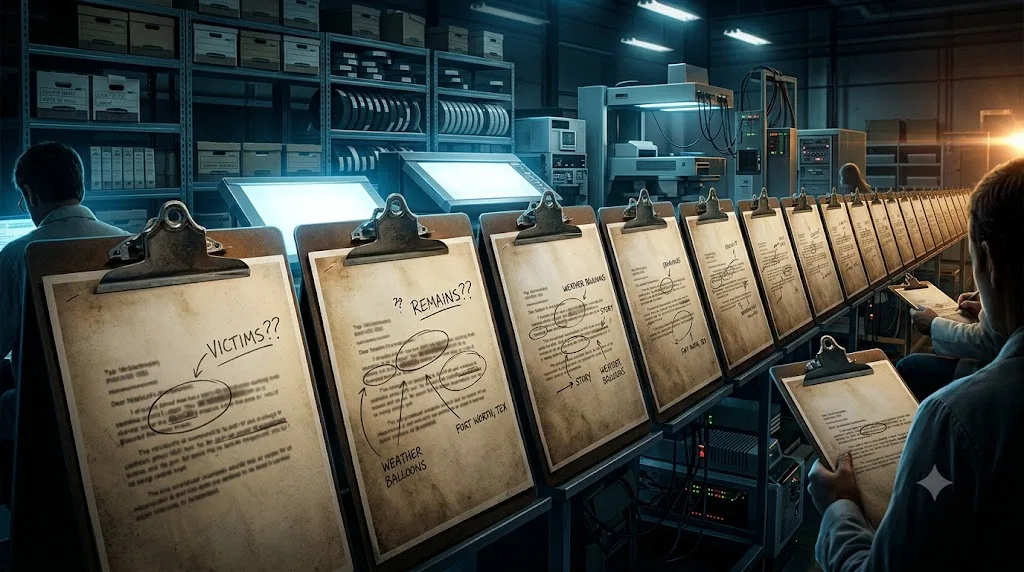
If the memo clearly contained decisive words, independent readers should see the same words in the same places.
On this page
- What reliability means
- Where readings converged
- Where readings broke apart
Page outline Jump by section
Introduction
The best test of the Ramey memo is not whether one reader feels confident about a phrase. It is whether independent readers, given the same blurred patch of 1947 news photography, repeatedly see the same words in the same positions. On that standard, the memo produces a mixed result. Some words and word clusters have attracted partial agreement, especially “Fort Worth, Tex”, “weather balloons”, “story”, and “land”. But the decisive phrases — the ones claimed to alter the Roswell case, such as “victims of the wreck” — have not achieved stable agreement across readers, methods, or expectation conditions. The result is important because the photograph itself is real and historically anchored: UTA describes the Ramey memo as housed in its Special Collections, tied to the Fort Worth Star-Telegram Roswell photo material. The dispute is therefore not over whether the image exists, but over whether the visible marks can bear the weight placed on them.[UTA]uta.eduThe Ramey Memo | UTA MagazineThe Ramey Memo | UTA Magazine…
What Reliability Means in the Ramey Memo Debate
Inter-rater reliability means the degree to which separate observers agree when assessing the same material. In ordinary research terms, it asks whether different raters are assigning the same judgement to the same target rather than producing personal, expectation-led interpretations. A PubMed-indexed review distinguishes inter-rater agreement from inter-rater reliability, but both concepts matter here because the practical question is simple: do different readers identify the same words, in the same lines, without needing the same prior belief or interpretive script?[PubMed]pubmed.ncbi.nlm.nih.govOpen source on nih.gov.
For the Ramey memo, this matters more than enthusiasm, technical vocabulary, or image-processing confidence. A reader may sincerely believe a word is visible; another may sincerely see a different word in the same place. If the memo clearly contained decisive language, independent readers should repeatedly recover that language. If the result depends heavily on who is reading, what they already believe, which enhancement they prefer, or whether they are primed to expect a Roswell cover-up, then the phrase is not functioning like legible text. It is functioning like an ambiguous stimulus.
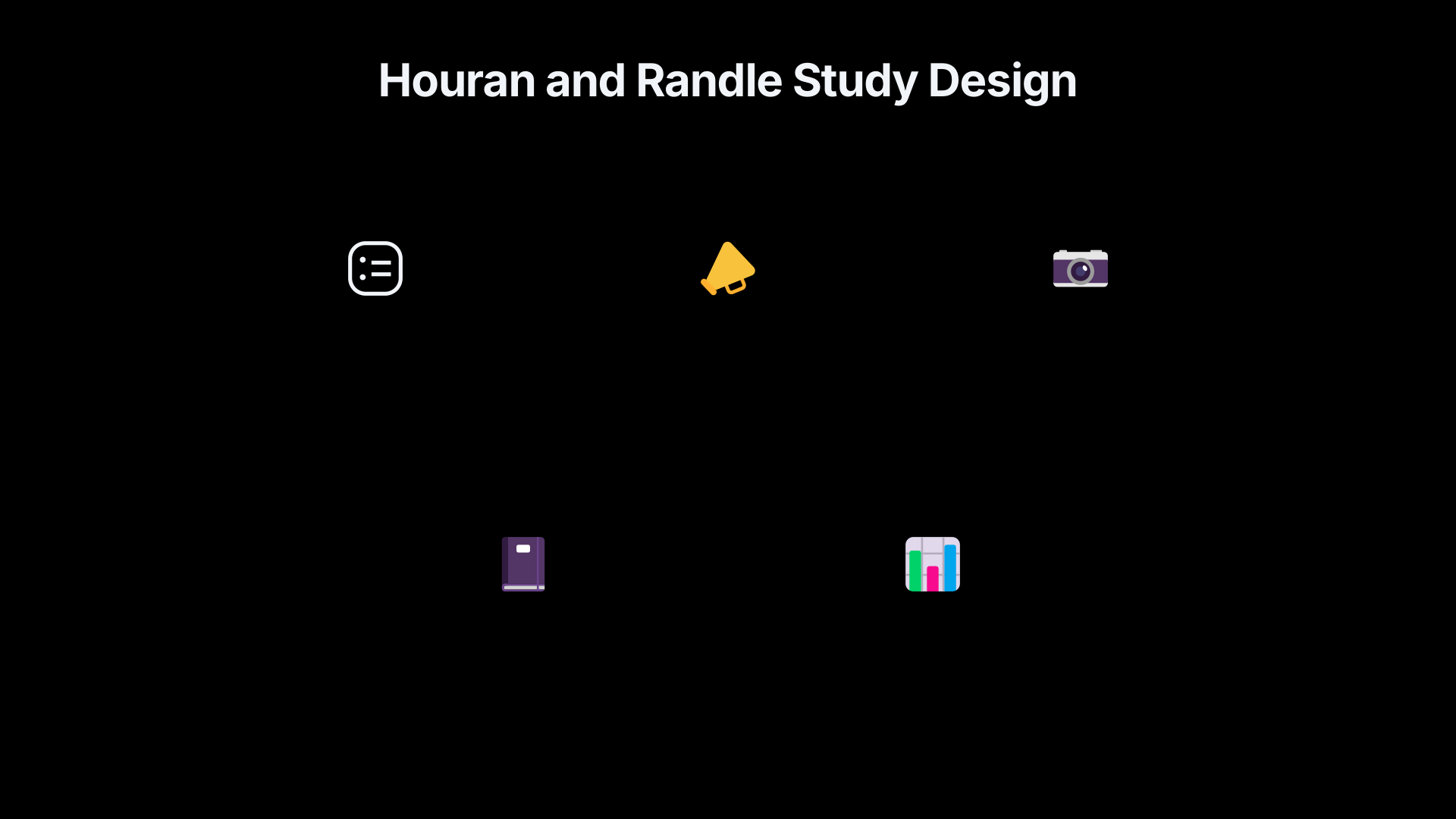
That distinction is the heart of James Houran and Kevin Randle’s 2002 study, “A Message in a Bottle”. The authors did not merely ask whether someone could propose a reading. They tested whether suggestion changed what people thought they could read. Participants were randomly assigned to three conditions: one group was told the document might concern the Roswell UFO case and a cover-up; one was told it might concern atomic bomb testing; and a blind group was told only that it was a photograph of a document.[ResearchGate]researchgate.netOpen source on researchgate.net.
The study’s design made a useful point for readers of the memo debate: when the image is ambiguous enough, context can become part of the “reading”. The authors expected suggestion to affect interpretation, but they also looked for agreement on specific words in the same locations, because genuine legibility should survive differences in expectation.[ResearchGate]researchgate.netOpen source on researchgate.net.
Where Readings Converged
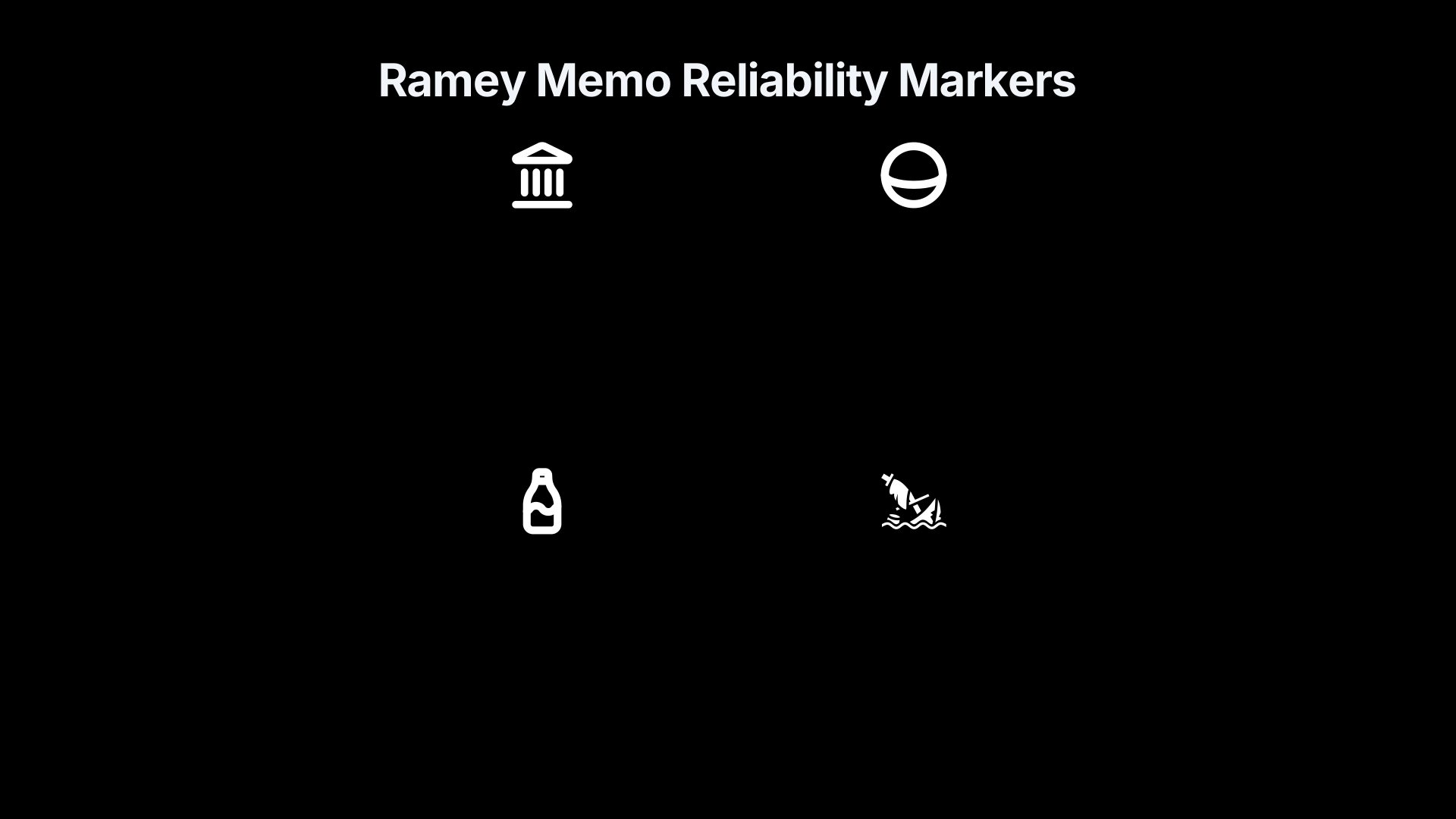
The strongest pro-reliability finding is that the Ramey memo is not pure visual noise. Houran and Randle reported that some words appeared across conditions or aligned with earlier specialist readings. Their Table 3 listed “Fort Worth TX” in all three groups, with 24 readers in the pro-UFO condition, 17 in the atomic-bomb condition, and 11 in the blind condition seeing it. “Story” also appeared in more than one condition, while “weather balloons” appeared in the pro-UFO and blind groups, though with very different counts.[ResearchGate]researchgate.netOpen source on researchgate.net.
That kind of convergence matters. It suggests that at least parts of the document may contain recoverable text or text-like structure. The authors themselves stated that the agreement on specific words in identical locations suggested that some of the document was indeed legible, even without computer enhancement. That is a more cautious conclusion than either extreme: it does not dismiss the memo as meaningless blur, but it also does not turn every perceived word into evidence.[ResearchGate]researchgate.netOpen source on researchgate.net.
The clearest clusters are not the most sensational ones. “Fort Worth, Tex” is plausible because it fits the visible setting and the known movement of the Roswell debris narrative to Fort Worth. “Weather balloons” is also contextually plausible because the public explanation in 1947 was balloon-related. “Story” and “land” are less decisive but show up often enough to be treated as possible rather than invented. These are the kinds of terms that can be discussed as candidate readings, provided they remain labelled as uncertain.
Later debate continued to recognise this split between partial legibility and full decipherment. In a 2015 post about new scans, Randle wrote that forensic photography experts had arranged new scans at UTA, with some files nearly 250 MB, but that the work had not produced universal conclusions. He released one of the better scans to invite wider inspection, while noting that the process had gone more slowly than expected.[kevinrandle.blogspot.com]kevinrandle.blogspot.comA Different Perspective: Digital Image of the Ramey MemoA Different Perspective: Digital Image of the Ramey Memo
That episode is revealing because it shows that better image access did not automatically settle the reliability problem. More pixels, larger files, and more readers can help only if they produce independent convergence. If they simply create more competing readings, they expand the debate without resolving it.
Where Readings Broke Apart
The reliability problem becomes acute around the very phrases that would make the memo historically explosive. Houran and Randle’s comparison table showed major differences among named interpreters, including Neil Morris, David Rudiak, Don Burleson, Tom Carey, and John Kirby. The table’s note explained that capital letters marked words the interpreter believed accurate, lower-case letters indicated best guesses, and the listed researchers had shared information while trying to decipher the message. That means the readings were not cleanly independent in the strongest possible sense, yet they still diverged sharply.[ResearchGate]researchgate.netOpen source on researchgate.net.
The most famous disputed phrase is often rendered as “victims of the wreck”. Morris’s early reading included something close to that, and David Rudiak has defended “victims” as the best reading in later debate. But alternative readings have included “remains”, “viewing”, “finding”, or more conventional debris-transfer language. In the same 2018 discussion, Randle said he could see both “victims” and “remains”, and that the memo still seemed to have two broad interpretations: one alien and one terrestrial.[kevinrandle.blogspot.com]kevinrandle.blogspot.comA Different Perspective: The Ramey MemoA Different Perspective: The Ramey Memo
That is precisely where inter-rater reliability becomes more important than rhetorical confidence. “Victims”, “remains”, and “viewing” do not have the same evidential meaning. If the word is “victims”, readers may infer bodies or casualties. If it is “remains”, the phrase could refer to debris. If it is “viewing”, the line may concern inspection or display. A single ambiguous word therefore carries a large interpretive load, yet the agreement around it is not strong enough to bear that load securely.
The disagreement is not limited to casual readers. Houran and Randle noted that even experienced memo researchers did not fully agree on the contents, and they described weak inter-rater reliability among earlier analysts using more sophisticated software. They also reported that Russ Estes, despite professional imaging equipment and high-resolution scanning, said he could not reliably decipher the text; when pressed, he offered only a limited-confidence guess at “Fort Worth, Tex”.[ResearchGate]researchgate.netOpen source on researchgate.net.
This is why reader agreement changes the evidential status of the memo. A phrase can be interesting without being decisive. It can be plausible enough to investigate while still being too unstable to use as proof. In the Ramey memo debate, the more consequential the proposed phrase, the more fragile the agreement tends to become.
Priming Is Not a Side Issue
Houran and Randle’s most important result was not simply that people disagreed. It was that the supplied context changed the number and type of words people reported. Participants in the pro-Roswell and atomic-bomb conditions produced significantly more words than the blind group: the reported means were 4.6 and 4.8 words for the two suggested-context groups, compared with 1.6 words for the blind control group.[ResearchGate]researchgate.netOpen source on researchgate.net.
The content of those readings also shifted with the prompt. The pro-UFO group produced words such as “remains”, “crash”, “UFO”, “story”, “weather balloons”, and “land”. The atomic-bomb group produced terms such as “glasses”, “flash”, “atomic”, “laboratory”, and “meaning”. The blind group produced far fewer scenario-rich terms. This is the key mechanism: when viewers are told what sort of story the image may contain, ambiguous marks become easier to organise into that story.[ResearchGate]researchgate.netOpen source on researchgate.net.
That does not prove every pro-Roswell reading is false. It does show that a reader’s interpretive frame can make the memo seem more readable than it is. In a tiny, angled, grainy document, the difference between seeing a word and completing a pattern can be very small. Once a reader has been told that the memo may contain “victims”, “wreck”, “disc”, or “weather balloons”, those possibilities become visual candidates.
The practical lesson is that any serious test should be blind where possible. Readers should not be told the hoped-for wording. Candidate words should be logged by line and position before comparison. Ideally, the same method should also be tested against control photographs of known 1940s military or wire-service text, photographed at similar distance and angle, so investigators can measure what their technique can and cannot recover. Houran and Randle themselves discussed a version of this control experiment: photograph known-era military messages under comparable conditions, then see whether the text can actually be deciphered.[ResearchGate]researchgate.netOpen source on researchgate.net.
Confidence Is Not the Same as Agreement
The memo debate often rewards confidence: a reader posts a reconstruction, labels certain words as clear, and argues from the resulting sentence. Inter-rater reliability asks a harder question: who else, working separately, gets the same sentence? The difference matters because confidence can rise as a person spends more time with an ambiguous image, even when the image itself has not supplied new information.
Randle’s later updates illustrate the problem well. In 2018 he described concerns from people involved in the work that repeated “enhancement” could become destructive rather than clarifying, and that new processed images might start to resemble something far removed from the original photographic grain. He also wrote that, despite progress and new attempts, the dispute remained basically in the same place: one interpretation pointed towards something alien, the other towards something terrestrial.[kevinrandle.blogspot.com]kevinrandle.blogspot.comA Different Perspective: The Ramey MemoA Different Perspective: The Ramey Memo
That is not a trivial admission. It means the central question is not whether more interpretations can be generated; it is whether interpretations are becoming more reproducible. If each enhancement produces a new apparent wording, the process may be amplifying pattern perception rather than revealing text. If different analysts using different methods converge on the same word positions without prompting, the evidential value rises.
The strongest words in the memo debate are therefore the least dramatic ones: “repeatable”, “blind”, “position-matched”, and “controlled”. A claimed reading is more useful when it survives those tests. A phrase that appears only under a favoured enhancement, or only after readers know what they are meant to find, should remain provisional.

Why the Memo Remains Evidence, But Not a Decisive Text
The Ramey memo remains important because it is attached to a genuine 1947 photograph, not to a late witness memory or a modern alleged secret document. UTA’s account places the memo within the Roswell-related Fort Worth Star-Telegram material and notes its continuing interest to ufologists. That provenance gives the object historical value.[UTA]uta.eduThe Ramey Memo | UTA MagazineThe Ramey Memo | UTA Magazine…
But provenance is not legibility. A real photograph can contain unreadable text. A historically important document can be photographed too poorly to reconstruct. A phrase can look persuasive to one reader and fail when tested against independent agreement. This is the gap that inter-rater reliability exposes.
The fair conclusion is a middle one. The memo is not worthless: some locations appear to produce recurring candidate words, and the repeated appearance of “Fort Worth, Tex” in particular is meaningful as a limited reliability signal. But the memo is not a secure Roswell “smoking gun”, because the high-stakes phrases have not produced the kind of independent, stable, blind agreement that would be expected from clear text. In evidence terms, the memo supports further controlled analysis more strongly than it supports any final reconstruction.
The reader agreement question therefore cuts through much of the noise. The issue is not whether “victims of the wreck” is an exciting possible reading. It is whether separate readers, protected from suggestion and using transparent methods, keep finding that phrase in the same place. So far, the record shows partial convergence on some ordinary words, substantial divergence on decisive ones, and a persistent risk that expectation is helping readers complete what the photograph itself leaves unresolved.
Amazon book picks
Further Reading
Books and field guides related to Why Agreement Matters More Than Confidence. Use these as the next step if you want deeper reading beyond the article.
The Demon-Haunted World
Rating: 4.5/5 from 43 Google Books ratings
Encourages evidence-based evaluation.
eBay marketplace picks
Marketplace Samples
Live-tested eBay searches with available results related to this page.


Endnotes
1.
Source: uta.edu
Title: The Ramey Memo | UTA Magazine
Link:https://www.uta.edu/utamagazine/spring-2017/stories/collected.php
Source snippet
The Ramey Memo | UTA Magazine...
2.
Source: researchgate.net
Link:https://www.researchgate.net/profile/James-Houran/publication/228706129_A_Message_in_a_Bottle_Confounds_in_Deciphering_the_Ramey_Memo_from_the_Roswell_UFO_Case/links/0deec527833e585cd6000000/A-Message-in-a-Bottle-Confounds-in-Deciphering-the-Ramey-Memo-from-the-Roswell-UFO-Case.pdf
3.
Source: kevinrandle.blogspot.com
Title: A Different Perspective: Digital Image of the Ramey Memo
Link:https://kevinrandle.blogspot.com/2015/10/digital-image-of-ramey-memo.html
4.
Source: kevinrandle.blogspot.com
Title: A Different Perspective: The Ramey Memo
Link:https://kevinrandle.blogspot.com/2018/12/the-ramey-memo-latest-information.html
5.
Source: kevinrandle.blogspot.com
Title: david rudiaks latest on ramey memo
Link:https://kevinrandle.blogspot.com/2018/12/david-rudiaks-latest-on-ramey-memo.html
6.
Source: researchgate.net
Link:https://www.researchgate.net/publication/362854511_A_Grounded_Theory_Update_on_the_Roswell_UFO_Incident
7.
Source: researchgate.net
Link:https://www.researchgate.net/publication/228706129_A_Message_in_a_Bottle_Confounds_in_Deciphering_the_Ramey_Memo_from_the_Roswell_UFO_Case
8.
Source: researchgate.net
Link:https://www.researchgate.net/profile/James-Houran/2
9.
Source: researchgate.net
Link:https://www.researchgate.net/publication/362854511_A_Grounded_Theory_Update_on_the_Roswell_UFO_Incident/fulltext/63a499df097c7832ca5912b6/A-Grounded-Theory-Update-on-the-Roswell-UFO-Incident.pdf
10.
Source: researchgate.net
Link:https://www.researchgate.net/figure/Close-up-of-the-memo-section-of-the-photograph-of-Brigadier-General-Roger-M-Ramey_fig2_228706129
11.
Source: researchgate.net
Title: 297491206 Ramey memo meant to deceive 3 multiple letters
Link:https://www.researchgate.net/publication/297491206_Ramey_memo_meant_to_deceive_3_multiple_letters
12.
Source: researchgate.net
Title: 395734150 Ramey Memo An In Depth Scientifically Based Deep Research Study
Link:https://www.researchgate.net/publication/395734150_Ramey_Memo-An_In_Depth_Scientifically_Based_Deep_Research_Study
13.
Source: researchgate.net
Title: 316041961 Inter rater Reliability
Link:https://www.researchgate.net/publication/316041961_Inter-rater_Reliability
14.
Source: sites.libraries.uta.edu
Link:https://sites.libraries.uta.edu/roswell/node/21
15.
Source: sites.libraries.uta.edu
Link:https://sites.libraries.uta.edu/roswell/home
16.
Source: sites.libraries.uta.edu
Link:https://sites.libraries.uta.edu/roswell/images
17.
Source: sites.libraries.uta.edu
Title: research team
Link:https://sites.libraries.uta.edu/roswell/research-team
18.
Source: pubmed.ncbi.nlm.nih.gov
Link:https://pubmed.ncbi.nlm.nih.gov/22695215/
19.
Source: digital.library.adelaide.edu.au
Link:https://digital.library.adelaide.edu.au/dspace/handle/2440/3334
20.
Source: pubmed.ncbi.nlm.nih.gov
Link:https://pubmed.ncbi.nlm.nih.gov/23110865/
21.
Source: pmc.ncbi.nlm.nih.gov
Link:https://pmc.ncbi.nlm.nih.gov/articles/PMC3900052/
22.
Source: pmc.ncbi.nlm.nih.gov
Link:https://pmc.ncbi.nlm.nih.gov/articles/PMC11290859/
Additional References
23.
Source: youtube.com
Link:https://www.youtube.com/watch?v=-Wfs2HfIsIo
Source snippet
Ramey memo Roswell UFO The Ramey Memo: Best Roswell Cover-Up Evidence ever Found AlienScientist...
24.
Source: youtube.com
Title: Cohen’s Kappa (Inter-Rater-Reliability)
Link:https://www.youtube.com/watch?v=z4CiQPV0Mgw
Source snippet
3 Types of Reliability (Test-Retest, Interrater, Internal)- Psychology Research Methods...
25.
Source: youtube.com
Title: The Ramey Memo: Best Roswell Cover-Up Evidence ever Found
Link:https://www.youtube.com/watch?v=z8VQwxF8gRQ
Source snippet
The Smoking Gun Of Roswell The Ramey Memo...
26.
Source: semanticscholar.org
Link:https://www.semanticscholar.org/paper/%22A-message-in-a-bottle%3A%22-Confounds-in-deciphering-Houran-Randle/0a08310d1ace75c161c8fef55cd69c68c89f7859
27.
Source: academia.edu
Link:https://www.academia.edu/35030468/Case_study_of_a_Close_Encounter_of_the_Third_Kind_Nancy_France_1969Hallucination_or_false_memory_SUNlite_vol_9_n_6_p_4_5
28.
Source: reddit.com
Link:https://www.reddit.com/r/UFOs/comments/1ij460d/i_transcripted_the_ramey_memo/
29.
Source: statisticsbyjim.com
Link:https://statisticsbyjim.com/hypothesis-testing/inter-rater-reliability/
30.
Source: statisticshowto.com
Link:https://www.statisticshowto.com/inter-rater-reliability/
31.
Source: medium.com
Link:https://medium.com/data-science/inter-rater-agreement-kappas-69cd8b91ff75
32.
Source: instagram.com
Link:https://www.instagram.com/reel/DL0J9SSshv3/
Topic Tree