Within Ramey Memo
When Better Scans Still Failed
Estes' inability to read the memo reliably is important because better equipment did not produce a decisive transcript.
On this page
- Professional imaging attempt
- Limited confidence words
- What failure teaches
Page outline Jump by section
Introduction
Russ Estes matters in the Ramey memo debate because his attempt is a strong warning against the simplest claim made for the photograph: that better equipment should settle the text. Estes was not casually squinting at a photocopy. He used a large University of Texas Library print, professional video and macro equipment, software, optical magnification and an extremely high-resolution scan. Yet his conclusion was not a dramatic transcript but a failure of reliable reading. At most, he offered limited-confidence impressions such as “Fort Work, Tex” and an unclear “ELA*”, while explicitly comparing some proposed readings to “faces in the clouds”.[ResearchGate]researchgate.netOpen source on researchgate.net.
That failure does not prove the Ramey memo is meaningless. It does show that “image enhancement” is not the same as recovery of lost information. In a case built around a tiny, angled paper in a 1947 press photograph, Estes’ result is one of the most useful caution points: professional imaging can enlarge ambiguity as easily as it can reveal text.
Why Estes Became a Test Case
The Ramey memo is the sheet of paper visible in Brigadier General Roger M. Ramey’s hand during the 8 July 1947 Fort Worth photo session connected to the Roswell debris story. The photograph has unusually strong provenance for a Roswell-related item: the original negatives made by Fort Worth Star-Telegram photographer J. Bond Johnson are held by the University of Texas at Arlington Special Collections, and UTA has also hosted high-resolution Ramey memo material for public examination.[Flickr]flickr.comRoswell UFO Incident, July 1947 |…
The controversy is not mainly over whether Ramey held a document. The issue is whether the visible marks on that document can be read with enough reliability to support a historical claim. The Air Force’s 1994 Roswell report said the photograph had been sent to a “national-level organisation” for digitising and photo interpretation, but that even after digitising the image was of insufficient quality to visualise the details sought.[ESD]esd.whs.milESDReport of Air Force Research Regarding the "RoswellSeptember 26, 2012 — 27 Jul 1994 — This organization reported on July 20, 1994, that even after digitizing, the photos were of insuffi-.R…
Against that background, Estes’ attempt became important because it tested a common expectation: if a government or earlier analyst failed, perhaps a motivated civilian using better gear could recover the hidden words. That expectation was not unreasonable. By the late 1990s, several researchers were trying larger prints, digital scans and enhancement software, and some were reporting phrases that seemed explosive for the Roswell case, including “victims” and “weather balloons”.[ResearchGate]researchgate.netOpen source on researchgate.net.
Estes’ work is useful precisely because it did not deliver the desired breakthrough. It was a serious attempt by someone sympathetic enough to examine the image carefully, yet cautious enough to admit when the source material would not support a firm transcript.

Professional Imaging Attempt
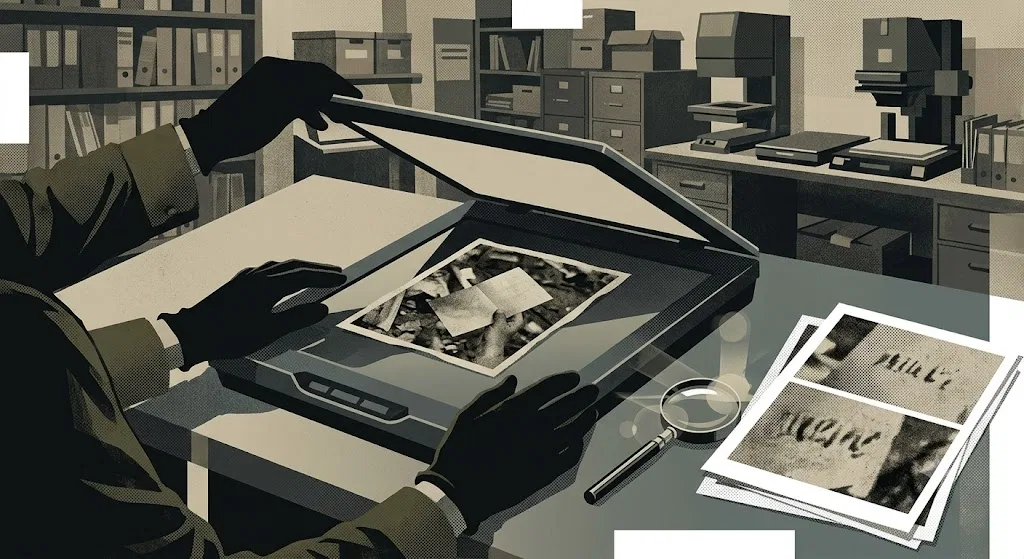
Estes worked from a 16 by 20 inch print made by the University of Texas Library. According to James Houran and Kevin Randle’s peer-reviewed discussion in the Journal of Scientific Exploration, Estes used a professional-quality video camera valued at about $50,000, a high-quality macro lens, computer enhancement software, a jeweller’s loupe, a magnifying glass and a microscope. He also scanned the image at 9000 dpi, creating a file large enough to be manipulated and enlarged further.[ResearchGate]researchgate.netOpen source on researchgate.net.
This matters because the Ramey memo debate often turns on the language of technical promise: enlargement, enhancement, scanning, filtering, sharpening and contrast adjustment. Those words can create the impression that poor visibility is merely a practical obstacle, not an evidential limit. Estes’ attempt exposed the difference. His equipment could make the memo larger and easier to inspect, but it could not make the underlying marks unambiguous.
The problem was not only resolution. The memo in the photograph is small, angled, unevenly exposed and embedded in the grain and tonal limits of the original image. Enhancement can change contrast and make patterns easier to see, but it cannot reliably distinguish a letter from a crease, a shadow, a film-grain pattern or a viewer’s expectation unless the source image contains enough recoverable structure.
That is why Estes’ result is more important than a simple “he failed” summary. He performed the kind of work that, in public discussion, is often treated as the route to certainty. His failure shows that the bottleneck was not merely access to expensive tools. The bottleneck was the quality and structure of the photographic evidence itself.
Limited-Confidence Words
Estes did not say that nothing at all could be seen. Pressed because other researchers claimed to read multiple words and phrases, he offered a “best guess”. He thought he could perceive something like “Fort Work, Tex” with limited confidence. That phrase is close to the more widely claimed “Fort Worth, Tex”, a location that makes sense in the setting of Ramey’s office at Fort Worth Army Air Field.[ResearchGate]researchgate.netOpen source on researchgate.net.
But the limited confidence is the point. Estes did not turn that impression into a stable line of text. On the line below, where others had proposed readings such as “Disk” or “ELSE”, he thought he saw “ELA*”, and he said that this made no sense to him. For the signature block, he saw nothing that firmly matched competing claims, though he allowed that there might be an “M” and perhaps “LE”, which only weakly favoured one proposed reading.[ResearchGate]researchgate.netOpen source on researchgate.net.
This is a sharply different outcome from the more assertive readings circulated by other investigators. Johnson’s team had proposed fragments including “THE VICTIMS OF THE”, “AT FORT WORTH, TEX”, “THE ‘CRASH’ STORY”, “EMERGENCY POWERS” and “WEATHER BALLOONS”. Neil Morris kept some elements, including “victims” and “Fort Worth, Texas”, but changed much of the surrounding text. John Kirby, using his own equipment and expertise, agreed on “At Fort Worth, Tex” but reportedly read the crucial line not as “victims” but as “are the remains of the material you commanded we fly”.[ResearchGate]researchgate.netOpen source on researchgate.net.
The contrast is revealing. If the memo were becoming clearer as techniques improved, one would expect convergence: different researchers, using different tools, arriving at the same core words. Instead, the results split. Some readings supported a dramatic Roswell interpretation; others softened or contradicted it; Estes could not reliably read the text at all.

Why Better Scans Still Failed
The central lesson from Estes’ work is that image enhancement cannot recover certainty from every degraded source. A scan at 9000 dpi can produce a large digital file, but if the original print and negative do not contain clean letter shapes, the scan mainly provides a larger field of ambiguous marks. Magnification may improve inspection while also making grain, smudges and compression of tones look more meaningful than they are.
Houran and Randle framed the Ramey memo as an ambiguous stimulus: a visual object that invites interpretation but lacks enough clarity to force agreement. Their study found that participants often claimed to read the memo, but their proposed solutions tended to follow the suggestions they had been given about the document’s possible context. They also reported that only a few words remained after controlling for context, and those words were ambiguous in their meaning.[ResearchGate]researchgate.netOpen source on researchgate.net.
That finding fits Estes’ “faces in the clouds” warning. The phrase is not a sneer at all investigation; it describes a real risk in visual interpretation. When people expect meaningful text, and when they already know the Roswell stakes, they may start resolving uncertain marks into words that match the story they are testing.[ResearchGate]researchgate.netOpen source on researchgate.net.
The problem also reaches beyond individual psychology. Researchers made assumptions about the kind of document being read. Estes and others noted that if it was teletype material, it would likely have been in all capitals. Houran and Randle also discussed complications about military message format, jargon, punctuation conventions and classification markings. If the document was a military message, some proposed readings should fit military style; if it was not, assumptions about military format may mislead the reading.[ResearchGate]researchgate.netOpen source on researchgate.net.
In other words, the memo is not just visually unclear. It is contextually underdetermined. Analysts do not merely ask “what letter is this?” They also ask, often unconsciously, “what kind of message would this be?” and “what words would make sense here?” Once those assumptions enter the process, the same smudge can become different words in different hands.
What Estes Changes in the Ramey Memo Debate
Estes’ work weakens the argument that decisive text is waiting inside the photograph if only the right equipment is used. It does not eliminate every possible reading, but it raises the evidential bar. A proposed transcript must explain why a professional, equipment-heavy attempt found only fragmentary, low-confidence impressions while other analysts produced much fuller and more consequential wording.
That matters especially for the phrase “victims of the wreck”. The phrase is important because, if secure, it would strongly challenge the idea that the Fort Worth debris display involved only balloon-related material. But Estes’ result shows that the phrase cannot be treated as secure merely because it has been repeated in Roswell literature. Other researchers disagreed with one another, and at least one technically equipped analyst read the crucial line in a less dramatic way.[ResearchGate]researchgate.netOpen source on researchgate.net.
The FBI’s 8 July 1947 teletype remains a useful comparison point because it is an actual contemporary document, not a reconstruction from a photograph. It describes an object near Roswell as resembling a high-altitude weather balloon with a radar reflector, while noting that it was being transported for examination.[FBI]vault.fbi.govRoswell UFOOnRoswell UFOOn The Ramey memo, by contrast, is a visible but unrecovered document whose supposed wording depends on interpretation of a tiny image.
This difference does not settle Roswell as a whole. It does clarify the specific evidential value of the Ramey memo. Contemporary documents can be quoted; the Ramey memo can only be proposed, line by line, with uncertainty attached. Estes’ failed reading makes that distinction harder to ignore.
What Failure Teaches
Estes’ failure is not an embarrassment to professional imaging. It is a useful demonstration of its limits. Professional tools can sharpen questions, expose weak claims and sometimes rescue detail. They cannot guarantee a transcript when the source image lacks enough reliable information.
The best use of Estes’ attempt is therefore methodological. It suggests several rules for reading the Ramey memo responsibly:
- Separate visibility from legibility. Marks that look like text are not automatically readable words.
- Treat equipment as a control, not a magic solution. Expensive cameras, macro lenses and high-dpi scans can still produce ambiguous outputs.
- Look for convergence. A credible decipherment should be reproducible across analysts who do not share the same expectations.
- Preserve confidence levels. “This might be Fort Worth, Tex” is a different claim from “the memo says victims of the wreck.”
- Avoid filling gaps from the story. Roswell context may guide hypotheses, but it can also smuggle the desired answer into the image.
The Ramey memo remains interesting because it is physically tied to the original 1947 press event and because some marks on the paper do appear word-like. But Estes’ professional imaging attempt shows why interest is not the same as proof. The photograph may contain traces of a real document, yet still fail as a decisive document. That is the uncomfortable middle ground the Ramey memo occupies: too suggestive to dismiss casually, too unstable to carry the weight placed on it.
Amazon book picks
Further Reading
Books and field guides related to When Better Scans Still Failed. Use these as the next step if you want deeper reading beyond the article.
The Roswell UFO Crash
Examines Roswell evidence and challenges to alleged document readings.
How to Read a Photograph
Relevant to interpreting visual information and photographic limits.
eBay marketplace picks
Marketplace Samples
Live-tested eBay searches with available results related to this page.
Endnotes
1.
Source: researchgate.net
Link:https://www.researchgate.net/profile/James-Houran/publication/228706129_A_Message_in_a_Bottle_Confounds_in_Deciphering_the_Ramey_Memo_from_the_Roswell_UFO_Case/links/0deec527833e585cd6000000/A-Message-in-a-Bottle-Confounds-in-Deciphering-the-Ramey-Memo-from-the-Roswell-UFO-Case.pdf
2.
Source: flickr.com
Link:https://www.flickr.com/photos/spcouta/36080122212
Source snippet
Roswell UFO Incident, July 1947 |...
Published: July 1947
3.
Source: sites.libraries.uta.edu
Link:https://sites.libraries.uta.edu/roswell/ramey-memo
Source snippet
Ramey Memo High Resolution Microfiche ScansHigh Dynamic Range photography has been used to harness the range of tones present with negati...
4.
Source: esd.whs.mil
Title: ESDReport of Air Force Research Regarding the “Roswell
Link:https://www.esd.whs.mil/Portals/54/Documents/FOID/Reading%20Room/UFOsandUAPs/rosswe1.pdf
Source snippet
September 26, 2012 — 27 Jul 1994 — This organization reported on July 20, 1994, that even after digitizing, the photos were of insuffi-.R...
Published: September 26, 2012
5.
Source: vault.fbi.gov
Title: Roswell UFOOn
Link:https://vault.fbi.gov/Roswell%20UFO
6.
Source: fbi.gov
Link:https://www.fbi.gov/video-repository/inside-the-fbi-ufos-102921.mp4/view
7.
Source: researchgate.net
Link:https://www.researchgate.net/publication/362854511_A_Grounded_Theory_Update_on_the_Roswell_UFO_Incident
8.
Source: researchgate.net
Link:https://www.researchgate.net/publication/228706129_A_Message_in_a_Bottle_Confounds_in_Deciphering_the_Ramey_Memo_from_the_Roswell_UFO_Case
9.
Source: researchgate.net
Link:https://www.researchgate.net/publication/362854511_A_Grounded_Theory_Update_on_the_Roswell_UFO_Incident/fulltext/63a499df097c7832ca5912b6/A-Grounded-Theory-Update-on-the-Roswell-UFO-Incident.pdf
10.
Source: sites.libraries.uta.edu
Link:https://sites.libraries.uta.edu/roswell/home
11.
Source: sites.libraries.uta.edu
Link:https://sites.libraries.uta.edu/roswell/node/21
12.
Source: sites.libraries.uta.edu
Link:https://sites.libraries.uta.edu/roswell/images
13.
Source: esd.whs.mil
Link:https://www.esd.whs.mil/Portals/54/Documents/FOID/Reading%20Room/UFOsandUAPs/RoswellReportCaseClosed.pdf
Additional References
14.
Source: youtube.com
Title: Kevin Randle Interviews
Link:https://www.youtube.com/watch?v=g7adHvPxHFE
Source snippet
"Ramey Memo" Roswell photo analysis The Ramey Memo - Poison in the Balls (LIVE) from the documentary SOCIAL MEDIA MONSTER sonnyboo...
15.
Source: youtube.com
Link:https://www.youtube.com/watch?v=–o0U5fQGwQ
Source snippet
Kevin Randle Interviews - BRENDA McCLURKIN - The Ramey Memo...
16.
Source: youtube.com
Title: Ron Regehr: A Forensic Analysis of the Ramey Office Photographs
Link:https://www.youtube.com/watch?v=FfsHHkhmTsk
Source snippet
Interview with Roswell "UFO debris" photographer, Star-Telegram reporter J. Bond Johnson; 1999...
17.
Source: nixonlibrary.gov
Link:https://www.nixonlibrary.gov/finding-aids/pre-presidential-papers-richard-m-nixon-correspondence-series-320
18.
Source: facebook.com
Link:https://www.facebook.com/ChesterfieldCountySheriff/posts/child-injured-in-dog-attack-owner-arrested-for-dangerous-animal-violationchester/1337679308395884/
19.
Source: reddit.com
Link:https://www.reddit.com/r/ufo/comments/1t7mqxl/did_the_us_just_quietly_confirm_the_roswell/
20.
Source: abcnews.com
Link:https://abcnews.com/Technology/fbi-vault-reveals-ufo-roswell-files/story?id=13347754
21.
Source: escholarship.org
Link:https://escholarship.org/content/qt617438sk/qt617438sk_noSplash_02017f32354516130f1320a10e92e96e.pdf
22.
Source: paradigmresearchgroup.org
Link:https://www.paradigmresearchgroup.org/News_Items-3.htm
23.
Source: facebook.com
Link:https://www.facebook.com/groups/THEUFOFILESGROUP/posts/1494050747699240/
Topic Tree